Magnetic-wheel drive grips steel directly — no track for straight runs, or an optional light track for circumferential welds. Works on pipes and curved steel from Ø108 mm outer diameter, inner diameter from Ø700 mm.
Also known as: crawler welding robot, automatic welding robot, welding crawler, magnetic crawler welding machine, welding robot carriage, trackless welding carriage.
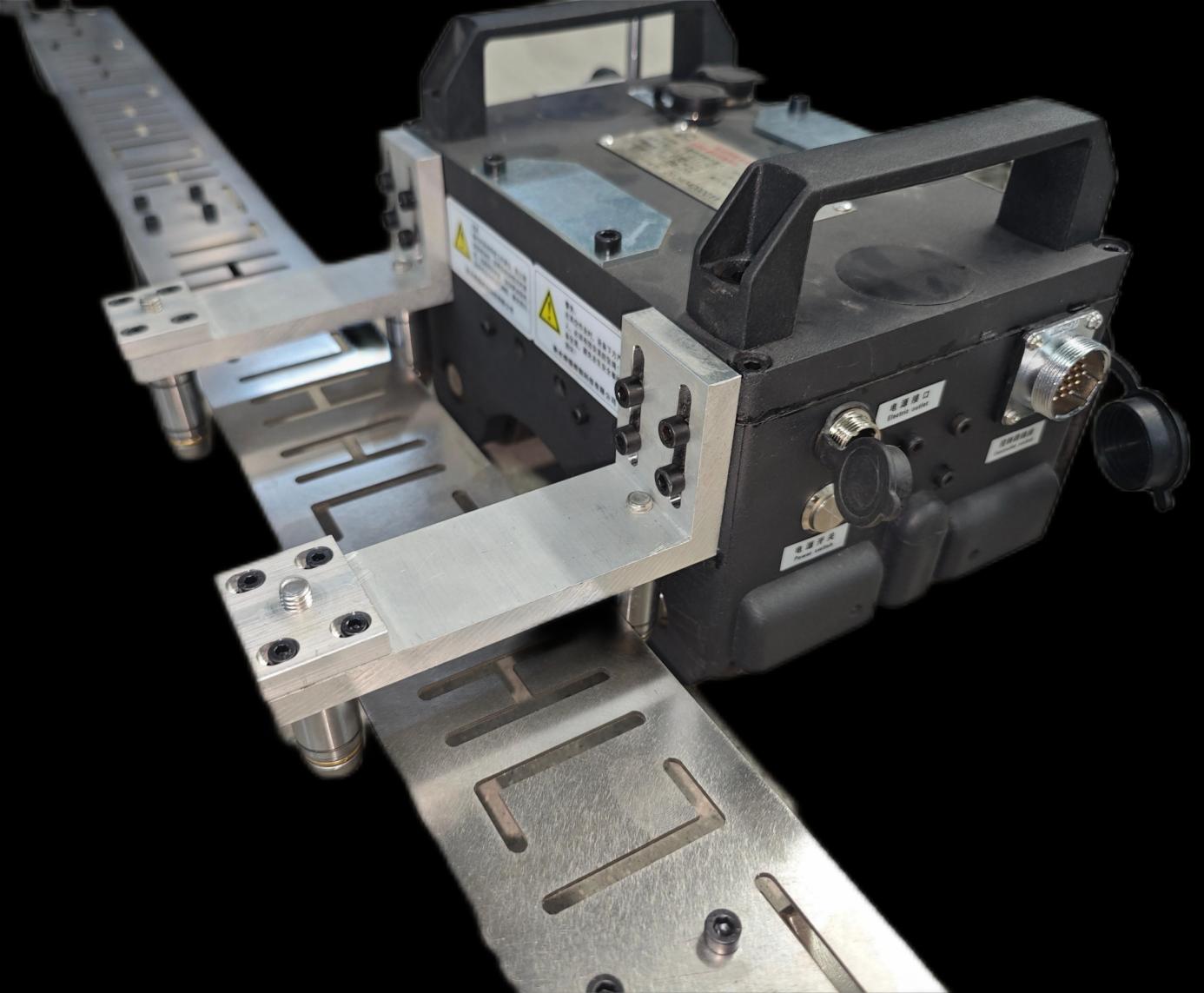
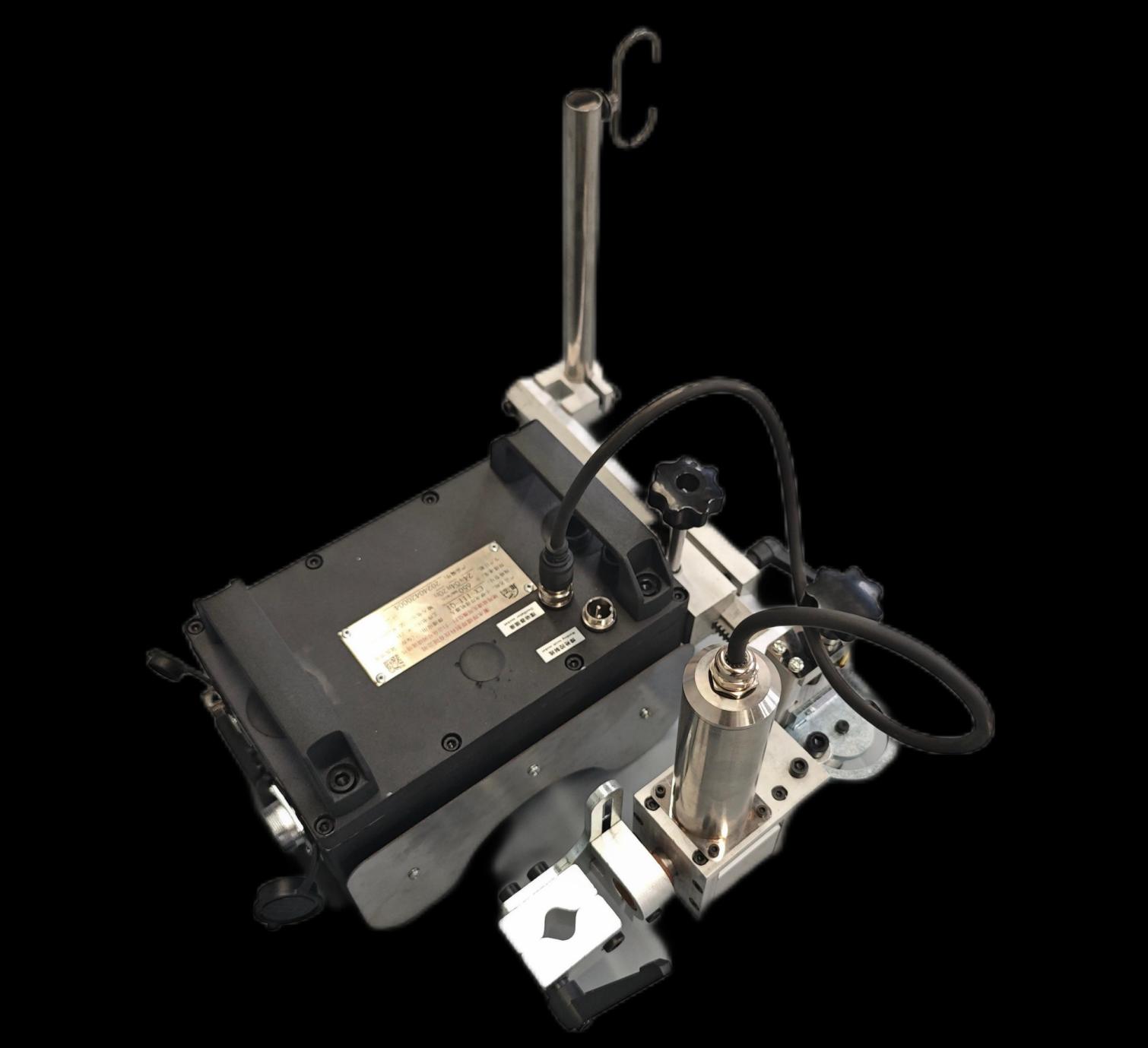
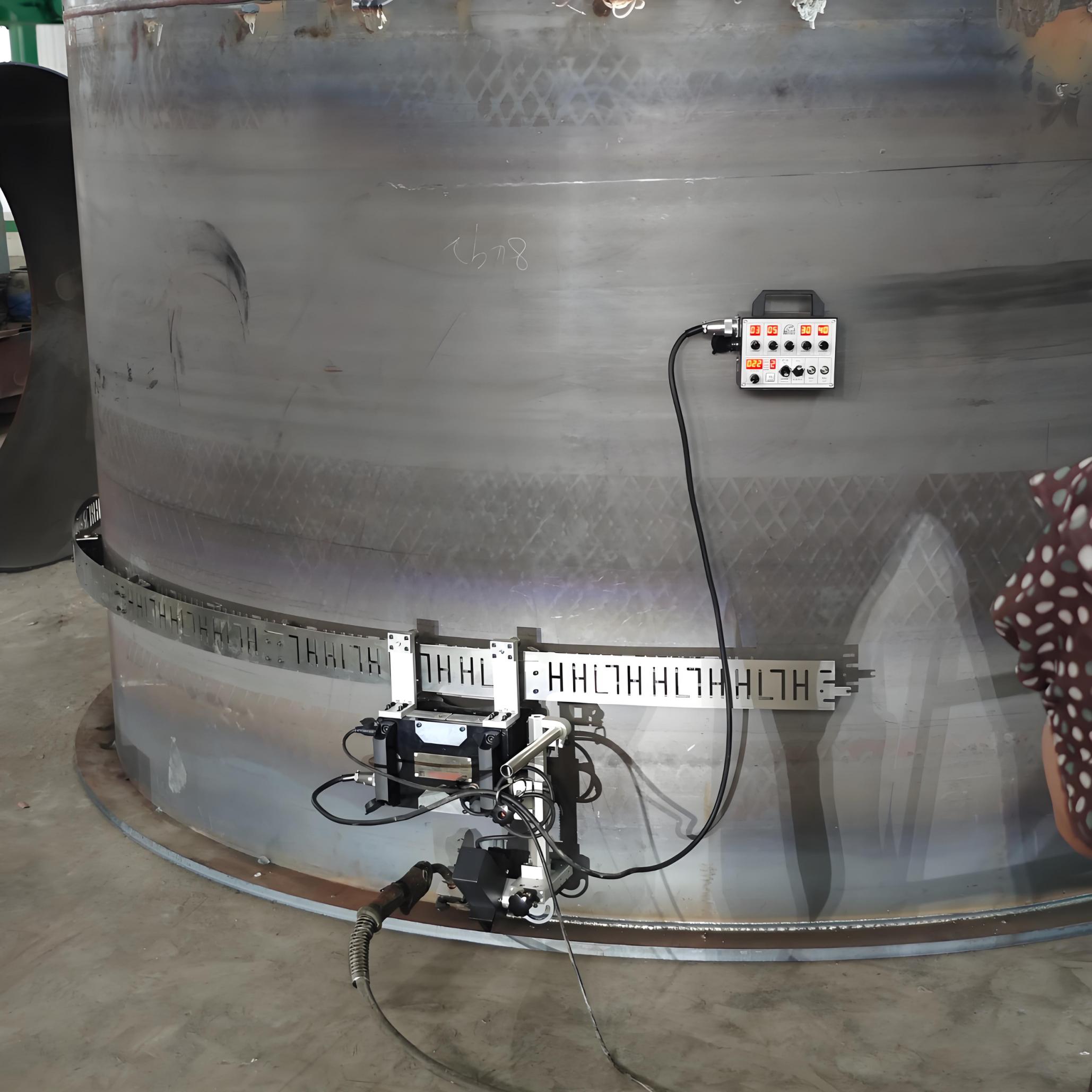
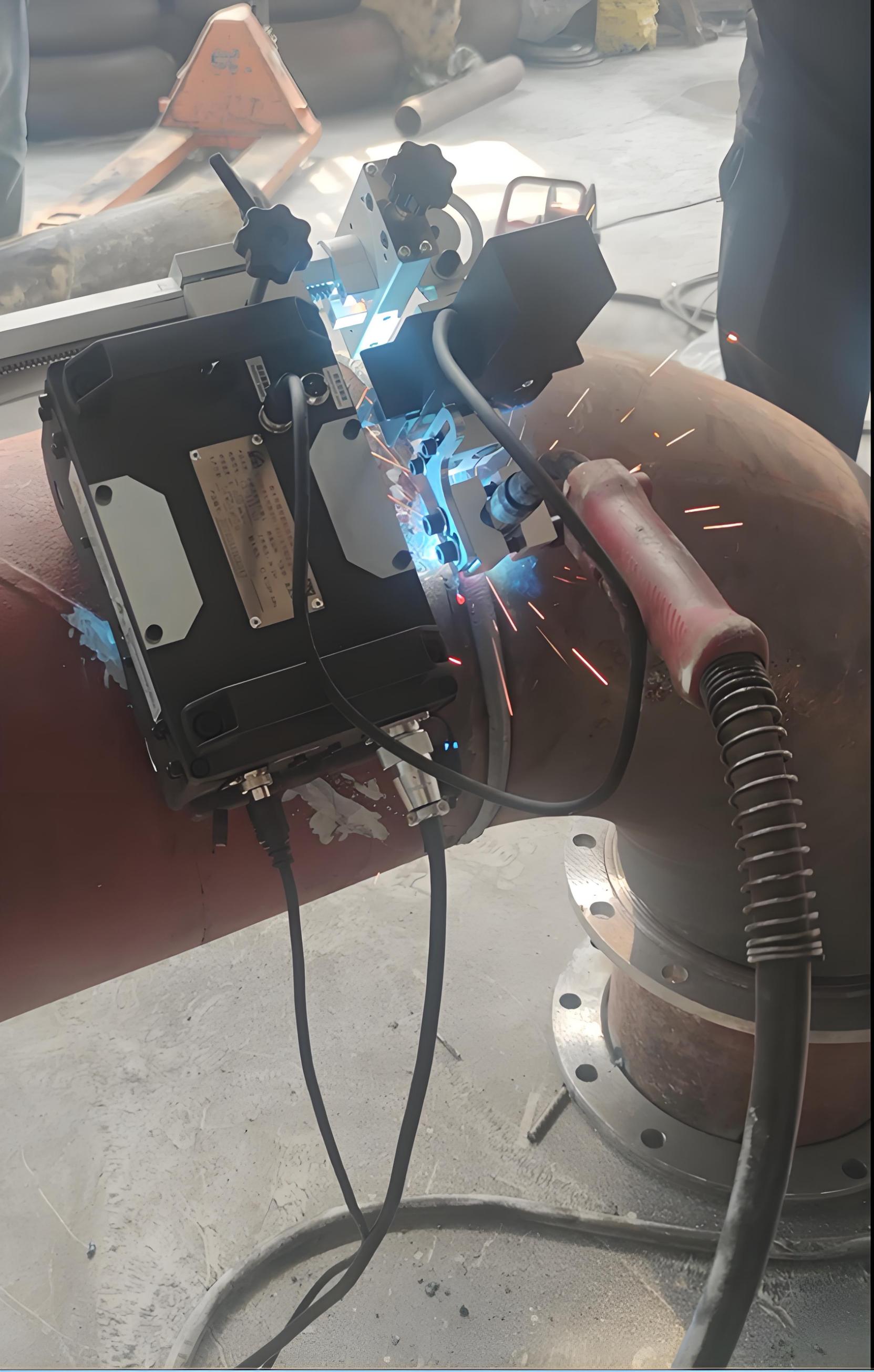
Magnetic wheels grip carbon steel directly — welds pipes and shells from Ø108 mm to Ø700 mm on plate from 3 mm. Add the optional track for larger diameters and the anti-drift fixture to keep the torch locked on the seam.
A crawler welding robot carries its own means of travel. There is no track to lay, no rotator and no fixture to build: permanent high-temperature magnets in the wheels grip the steel directly, and the carriage drives itself along the joint. You set travel speed, oscillation width, swing angle and dwell time once on the split controller, and the torch repeats the same pass on every joint after that.
Permanent high-temperature magnets in the wheels hold the carriage to bare steel from 3 mm upward. Adhesion does not depend on gravity, which is why the same setting works flat, vertical or overhead. Full strength is held below 580 °C, and there are no wearing friction parts in the travel path.
The carriage travels the seam without a track — a straight run on a shell, a full circumference on a pipe, or a curve on a dished end — at 0–650 mm/min with the speed shown on a digital display. Because it is trackless, repositioning between joints takes seconds.
The powered oscillator sweeps the torch across the seam to fill it evenly: 0–32 mm swing width, 30° swing angle on the angle-swing version, 0–2700 mm/min swing speed, with independently adjustable left and right dwell and ±5 mm centre-offset compensation for a wandering joint.
Because travel, oscillation and the wire feed are each set independently on the Gen-III controller, bead width and penetration stay the same from the first joint to the hundredth — which is the whole point of automating a circumferential weld.
Send a photo of the joint and tell us the pipe diameter, the weld position and the steel thickness. We will say straight away whether a trackless crawler fits, or whether a tracked carriage is the better answer.
Send a Photo, Get an AnswerThe crawler travels on its own magnets; a tracked carriage follows a rail you lay down first. Which one you need comes down to the shape of the seam: a circle on a curved surface, or a long straight line on a plate.
| Type | How it travels | Best for | Typical workpiece | Series |
|---|---|---|---|---|
| Magnetic crawler welding robot | Magnetic wheels, trackless | Circumferential seams, curved plate, vertical and overhead positions | Pipe Ø108 mm and up, shells, tank walls | CX-III-Q1/Z · CX-III-Q1/J |
| Flexible-track carriage | Flexible magnetic or vacuum track | Long seams on flat or curved plate, vertical shell seams | Tank shells Ø1800 mm and up, pressure vessels | RG series |
| Straight-rail carriage | Rigid rack rail | Long straight butt seams where the line must be dead straight | Plate, box beams, panels | ZG series |
| Fillet & corner carriage | Track or magnetic wheels | Fillet and corner seams, including twin-torch passes | H-beams, box sections, frames, columns | JJ · GJ · CZ |
| Tube-to-tubesheet machine | Servo rotating welding head | Tube-to-tubesheet joints, one standard per joint | Boiler, exchanger and condenser tube plates | HLGB25-108 |
Still not sure which type your workpiece needs? Answer a few questions in the selection guide and it will point you at the right series.
Every Little Gecko carriage drives a wire-fed MIG/MAG torch. Bring any MIG/MAG power source, torch, wire feeder and wire that supports the process — the carriage takes over travel, oscillation and the trigger. Stick (SMAW) electrodes are not supported: a consumable electrode that shortens as it melts cannot be fed at a constant rate, so there is no way to automate it. Wire makes automation possible.
What you get: the carriage, oscillator, track and control box. What is not included: welding machine, torch, wire feeder, welding wire and gas — you use your own. The carriage connects to your power source and wire feeder through a two-pin ignition control lead, and the universal torch fixture takes Ø18–25 mm torches (200–500 A). Not sure your machine fits? Send us the model and we will confirm before you order.
| Item | Specification |
|---|---|
| Carriage model | CX-III-Q1/Z (straight swing) · CX-III-Q1/J (angle swing) |
| Drive mode | Magnetic-wheel drive |
| Welding speed | 0–650 mm/min (digital display) |
| Minimum suction thickness | 3 mm (magnetically permeable material) |
| Welding diameter range (outer) | Ø108 mm and above |
| Minimum welding inner diameter | Ø700 mm |
| Carriage dimensions (L×W×H) | 335 × 305 × 312 mm |
| Carriage weight | 12.8 kg |
| Swing mode | Straight swing / angle swing |
| Swing width | 0–32 mm (digital, simulated value) |
| Swing angle | 30° (angle-swing version) |
| Swing speed | 0–2700 mm/min |
| Dwell time left / right | 0–4 s each |
| Centre offset compensation | ±5 mm |
| Torch adjustment — vertical | 65 mm (vertical slide) |
| Torch adjustment — horizontal | 125 mm (main unit left/right rail) |
| Oscillator rotation | ±60° |
| Torch nozzle travel angle | ±25° |
| Magnet wheel tolerance | Permanent high-temperature magnets hold full strength below 580 °C; no wear, no track required |
| Controller | Gen-III split controller with 7-pin aviation socket for the optional intermittent welding module |
| Standard configuration | Carriage ×1 · Gen-III controller ×1 · Gen-III power unit ×1 · Gen-III straight/angle oscillator · Universal horizontal and vertical adjustment · Universal torch fixture ×1 · Torch cable support ×1 · Tool kit ×1 · Documents ×1 · Packaging ×1 |
Full technical data for this machine in a printable English PDF — specifications, configuration and options. Hand it to your engineering team.
Download Datasheet (PDF)Values are taken from the product operation manual. Custom configurations — track length, torch fixture, dual-torch setup, expanding-head size — are quoted to your workpiece.
Naming guide: CX-III-Q1/Z-W = magnetic straight swing · CX-III-Q1/J-W = magnetic angle swing · optional magnetic track and anti-drift fixture available for both.
Machines are specified by weld type and workpiece, not by catalogue page. See how this series is used in real fabrication work:
Send us the pipe diameter and weld position — we'll confirm whether trackless or tracked configuration fits best.