Little Gecko® welding carriages · Engineering, QC & worldwide export from Beijing, China
Home / Applications / Shipbuilding

Shipbuilding Welding Automation — Panels, Decks & Bulkheads

Shipyards do not sell one-off welds; they sell the same seam, hundreds of times. Our welding carriages are built for exactly that repetition — straight seams on panels, fillets on stiffeners, day after day.

Shipbuilding Welding

One welder, two or three carriages, one bead standard

Panel lines live and die by seam metres per shift. A manual welder dragging a six-metre butt seam needs skill and stamina; output drops through the afternoon and bead quality drifts with fatigue. A carriage holds the set speed and torch angle to the end of the shift — and to the end of the year.
  • Butt and fillet seams on hull panels, deck plating and bulkheads
  • Carbon steel plate from 3 mm, panel seams several metres long
  • Flat and slightly curved sections — workshop, panel line or open dock
  • 1.5× the output of manual welding per machine; one operator can run 2–3 carriages
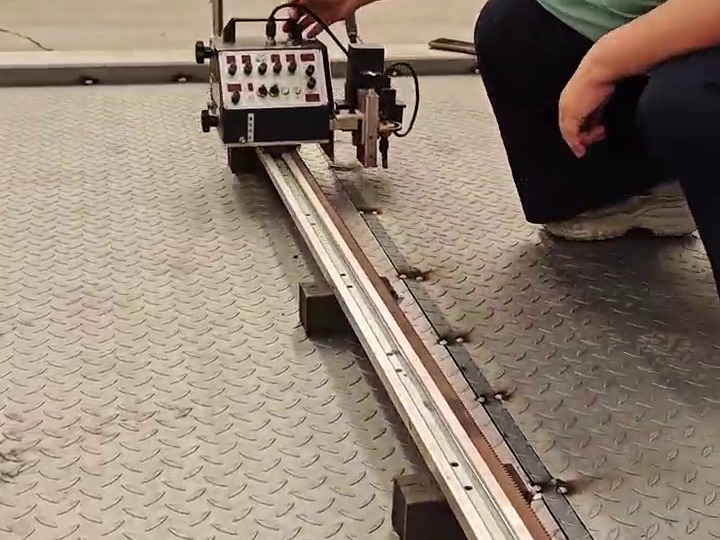
What we recommend: ZG-III-Q1 straight-track carriage with magnetic fixing for panel butt seams — straight swing for flat seams, angle-swing JJ fillet carriages for stiffeners and frames. Split type with battery pack where the panel is far from a socket.
The difference: The carriage holds speed and torch angle along the whole seam, adjustable 0–1100 mm/min. Beads look the same on panel 50 as they did on panel 1 — fit-up rework drops, and welding stops being the bottleneck of the panel line.
See the ZG Straight-Track Carriage
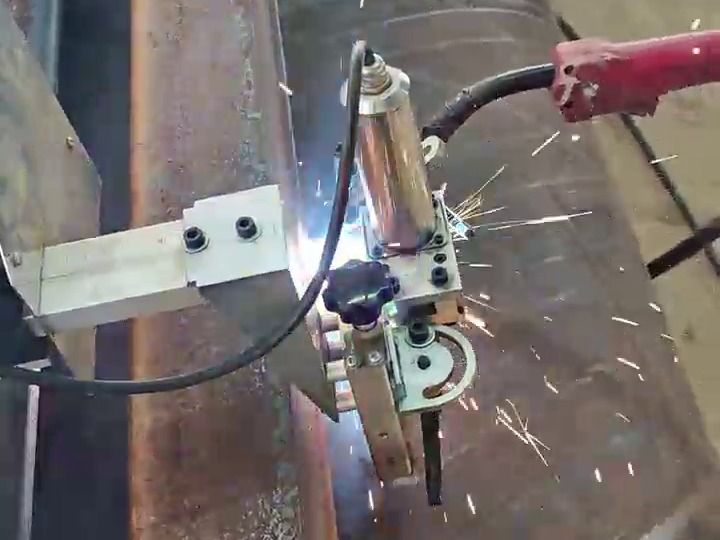
ZG straight-track welding carriage running on hull panel seam — real workshop photo Straight-track carriage welding with arc and sparks — shipyard panel seam
Seam Types We Cover

Which Carriage Welds What in Shipbuilding

Typical joint / seamRecommended machine
Long butt seams on hull & deck panelsZG-III-Q1 straight-track carriage
Fillet welds on stiffeners, frames & bulkheadsJJ rubber-wheel fillet carriage
Both fillets of a frame in one passJJ-Q2 dual-torch carriage
Curved shell sections near the bow/sternRG-III-Q1 flexible-track carriage
Watch It Work

Automatic Long Seam Welding on Ship Panels

Straight-track carriage welding a long seam on plate — real footage
FAQ

Shipbuilding Welding — Common Questions

Can the carriage work in an open dock, away from mains power?
Yes — order the split type with the battery power pack. The carriage itself runs on DC 24 V, so a battery pack covers a full shift of panel welding where sockets are not reachable. The track fixes to the steel magnetically, so no fixtures or scaffolding are needed on the panel.
How does it handle the long seams typical of hull panels?
Each straight rail is 1960 mm and rails join in seconds, so seam length is effectively unlimited — move the rear rail forward as the carriage passes. Speed stays constant from 0 to 1100 mm/min with digital display, and the two travel-limit switches stop the carriage automatically at set positions.
We weld both flat butt seams and stiffener fillets — one machine or two?
Two, and they share the same control logic. The ZG straight-track carriage covers butt seams; the JJ rubber-wheel carriage rides the joint directly for fillet welds with no track at all. Shops usually start with one of each and scale per line.

Welding Panels for Hulls, Decks or Bulkheads?

Send us the plate thickness and typical seam length — we will configure the carriage set and quote within 24 hours.

Get a Quote