A high-elastic stainless-steel belt track that clings to curved shells and large-diameter workpieces — weld vertical, horizontal and circumferential seams on tanks from Ø1800 mm upward. Three track types cover carbon steel, stainless steel and annular workpieces.
Also known as: flexible track welding carriage, flexible-track welding tractor, rail welding carriage for curved seams, tank shell welding machine, crawler-type automatic welding machine.
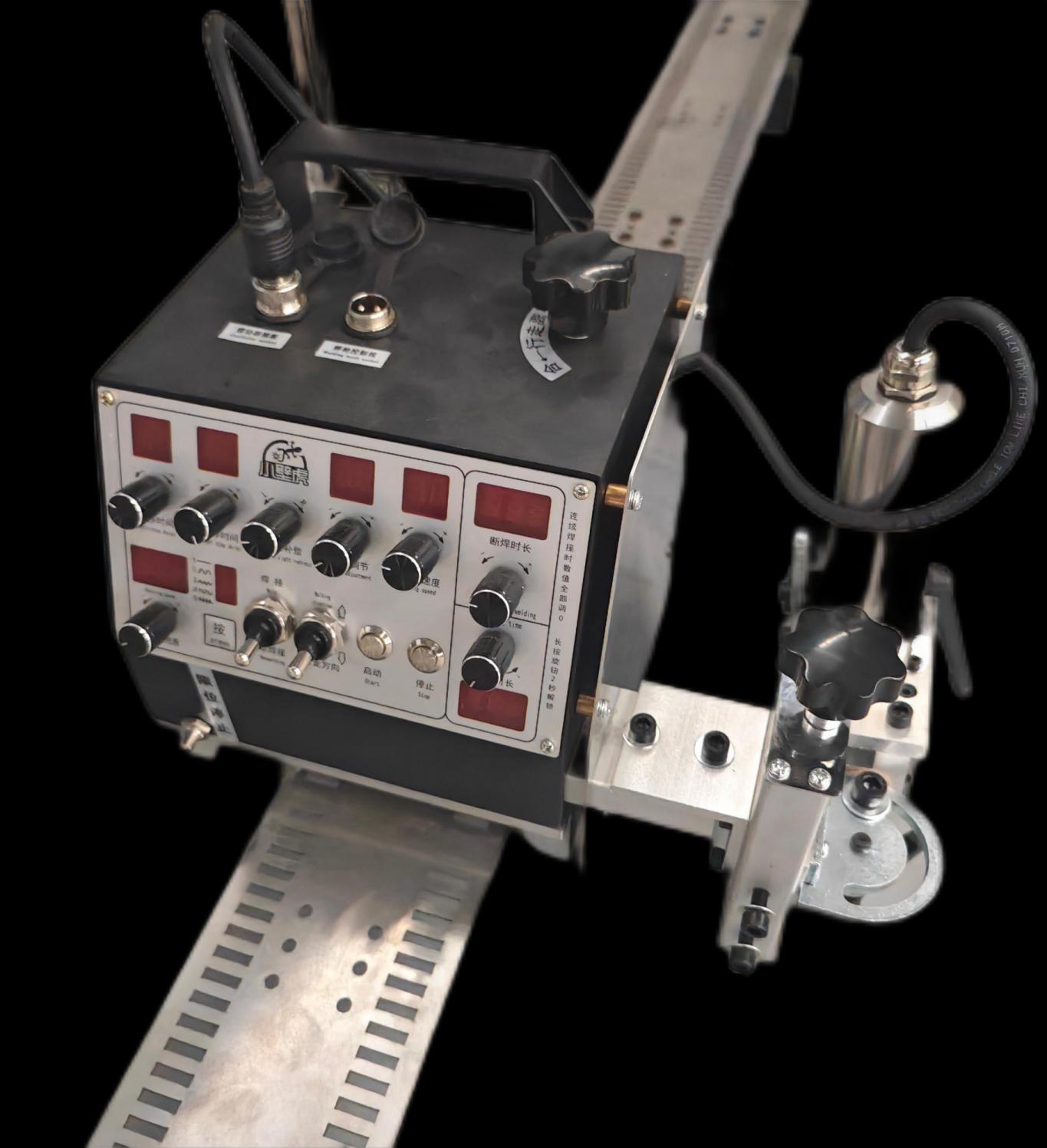
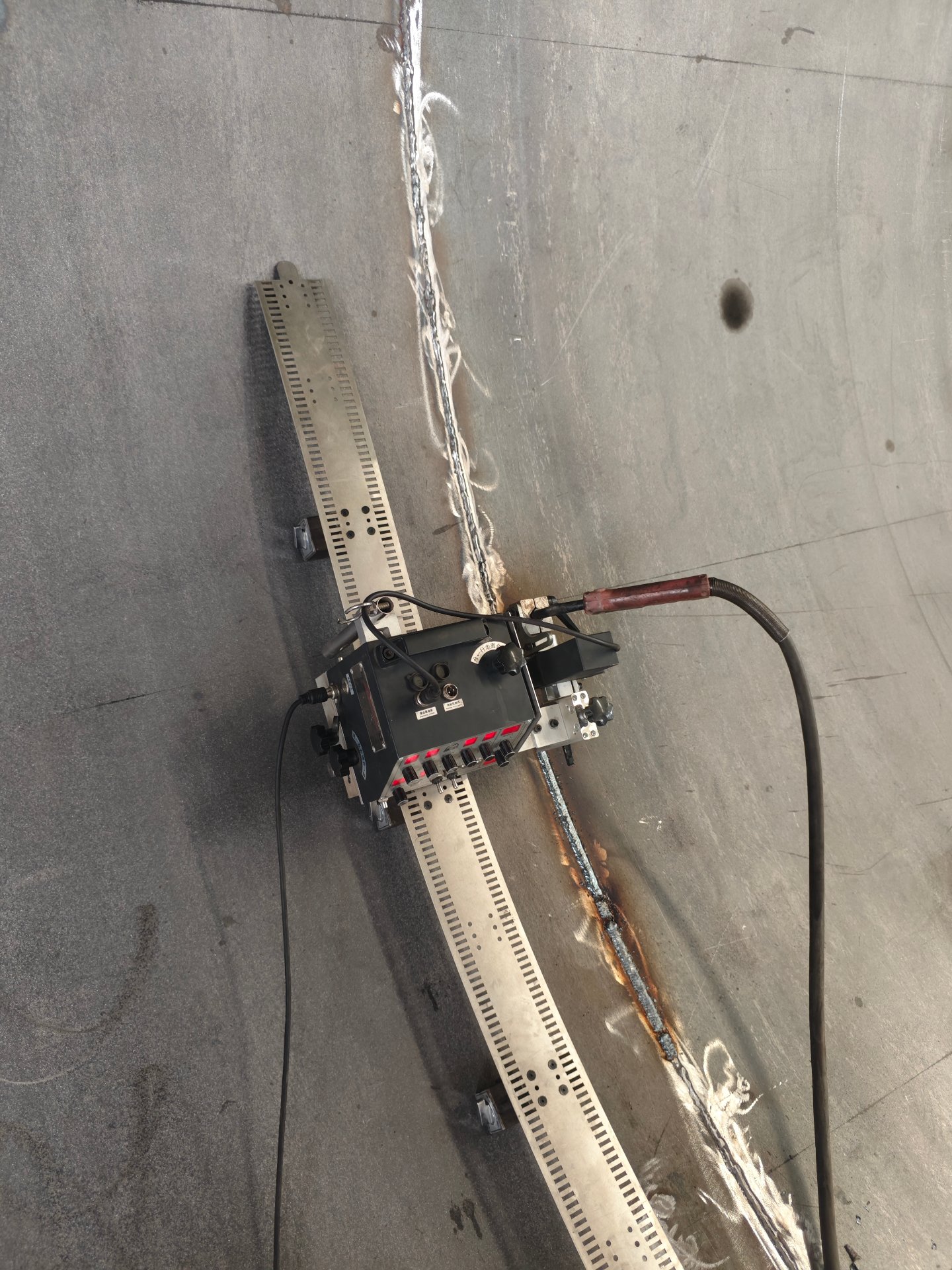
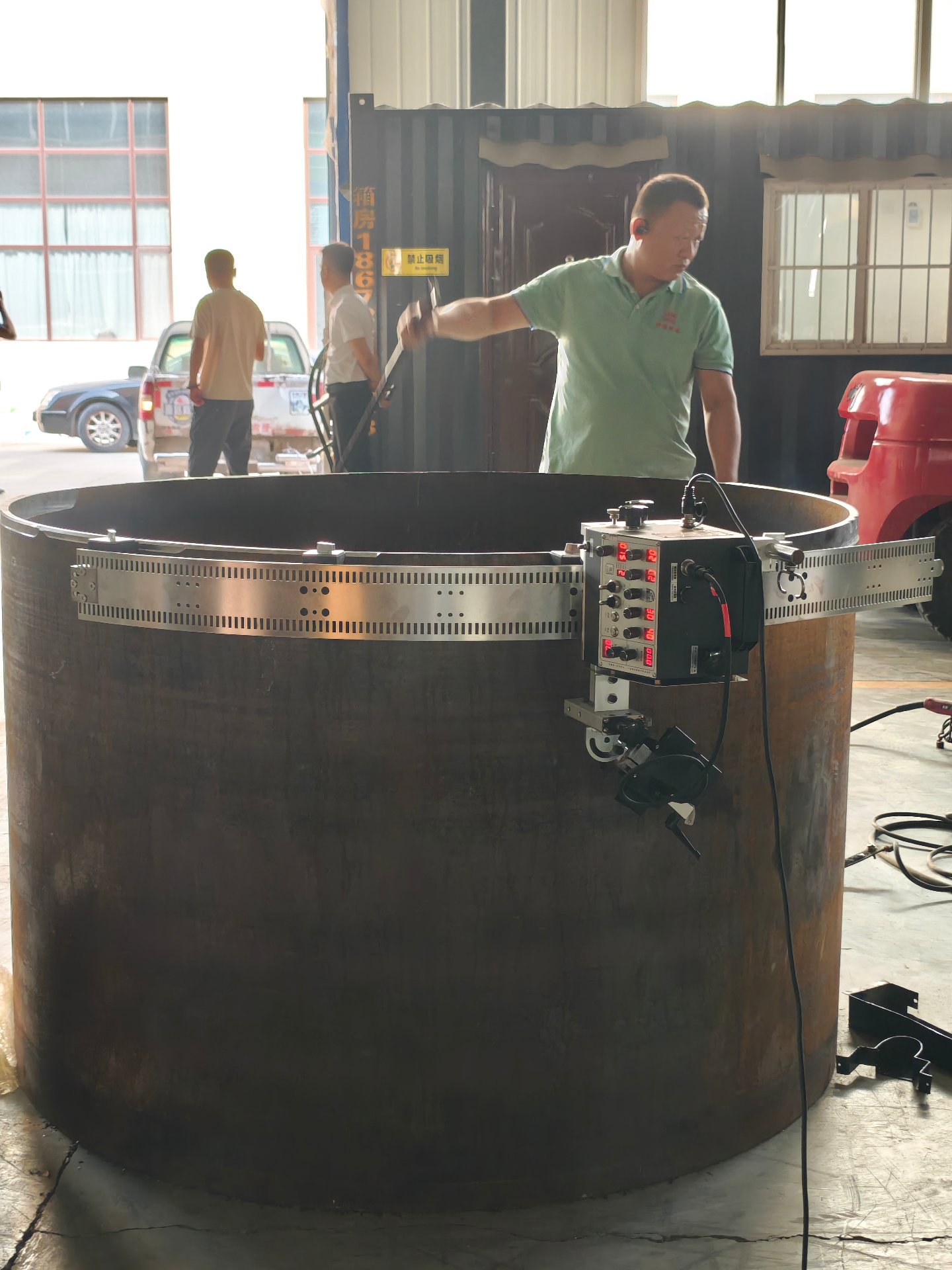
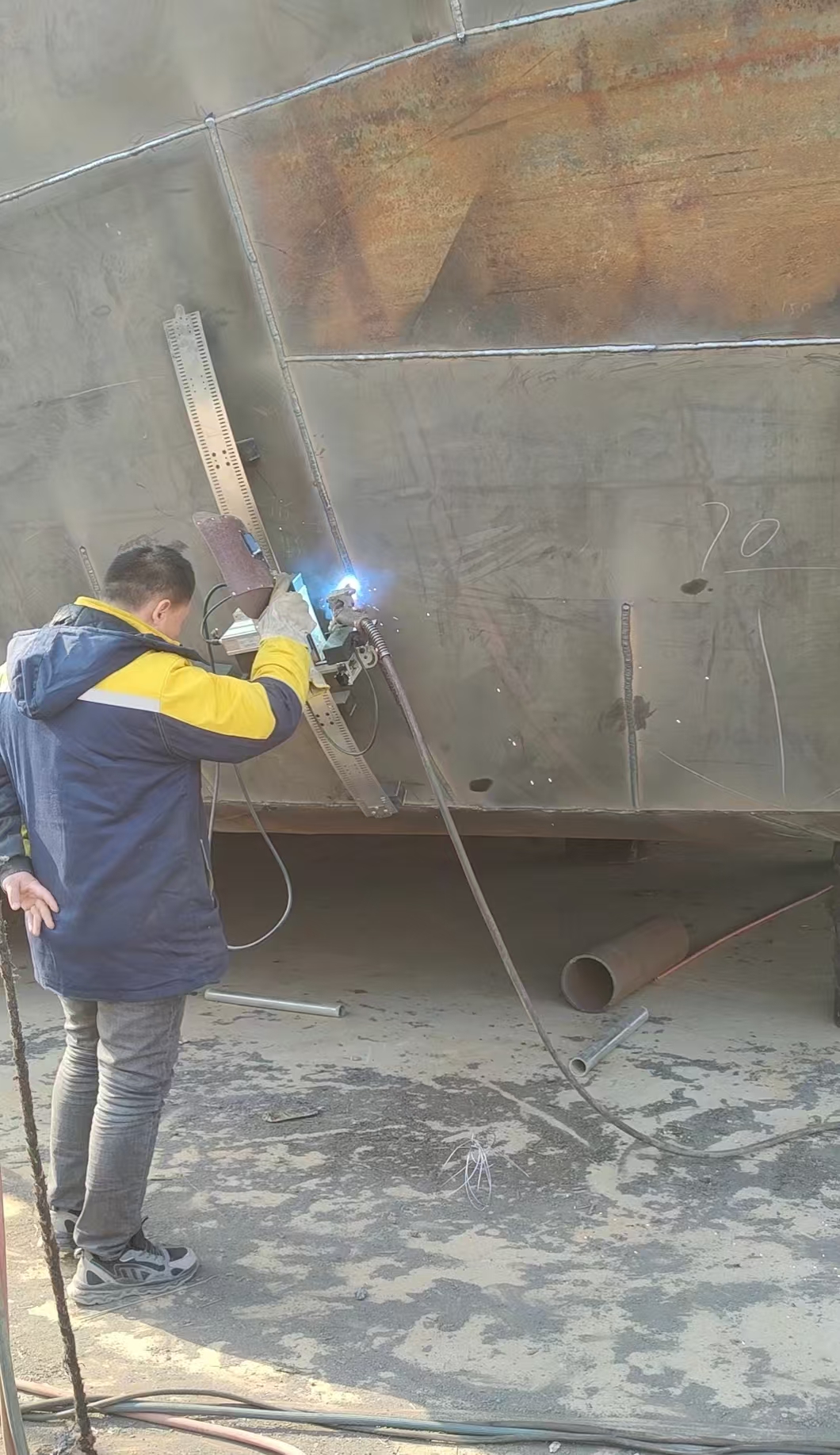
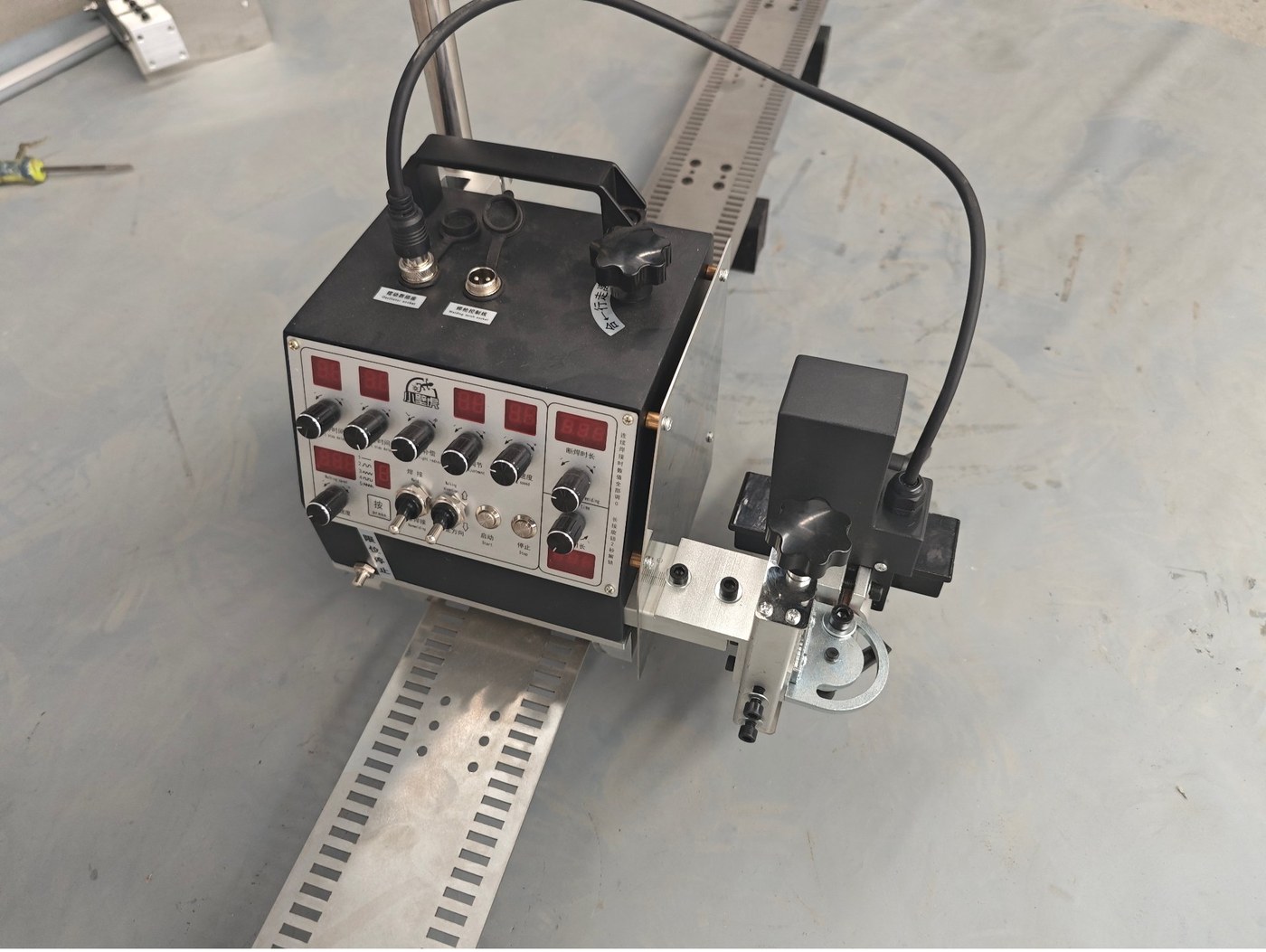
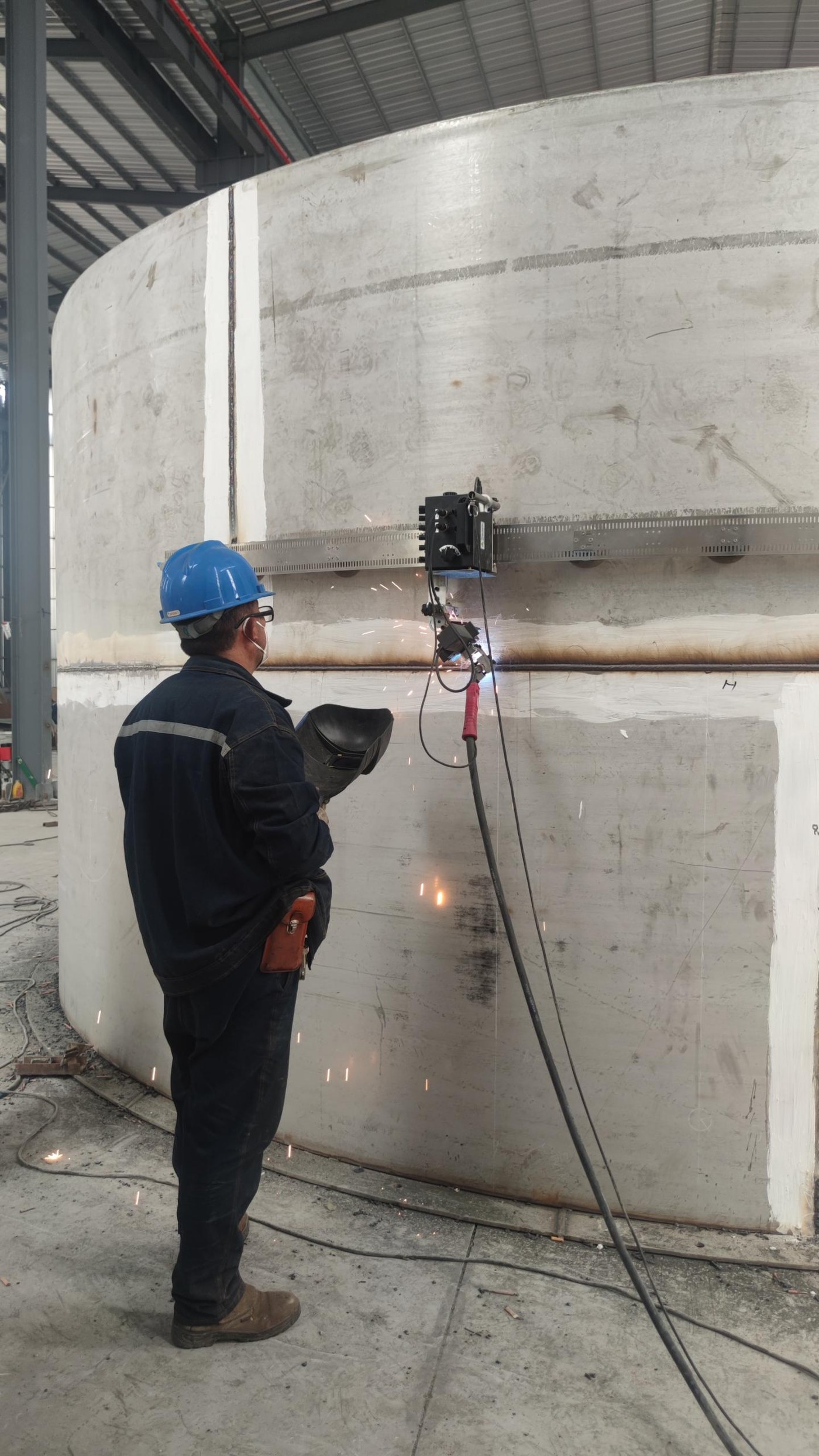
Purpose-built for tank and shell work: the belt track is held by strong magnetic adsorption on carbon steel plate from 3 mm — inside or outside the tank, welding horizontal, vertical and flat-position long straight seams on shells from Ø1800 mm upward.
A flexible-track carriage does not need a straight run of rail. A high-elastic stainless-steel belt is fixed to the shell — by magnetic blocks, vacuum suction cups or a clamping tensioner — and the carriage runs along it on sprocket drive. Set travel speed, weave form and dwell once on the Gen-III controller and the same bead repeats all the way around the seam.
The track is a 1784 × 102 × 2 mm stainless-steel belt with high hardness, high elasticity and self-recovering flatness. It is laid parallel to the seam and fixed to the shell — magnetic blocks (type /C), vacuum suction cups (type /X) or a 2 t tensioner (type /B). Track pieces use quick-plug joints, so any seam length is covered by linking rails, and one rail mounts in about 15–20 s.
The main unit runs on the track by sprocket drive, so it neither wanders nor sinks — on a vertical shell or under a tank roof. Travel speed is set digitally from 0 to 1100 mm/min, and the 8.7 kg carriage holds it around the whole circumference.
The oscillator sets the bead profile: 0–32 mm swing width, 0–2700 mm/min swing speed, 0–4 s dwell left and right, and ±5 mm centre compensation. The oscillator rotates ±60° and the nozzle travels ±25°. Five weave forms are built in — straight line, trapezoidal, positive sawtooth, castellated (Great Wall) and diagonal sawtooth.
All parameters are digital, and the controller restores the last set automatically after power-off. Two limit switches stop the weld at the end of the run. Intermittent (stitch) welding is built in: 0–99.9 s welding and 0–99.9 s gap.
It comes down to what the shell is made of and whether you weld inside or outside. Send us the tank diameter, plate thickness and material — we will confirm the track type and quote it.
Send the Spec, Get an AnswerPhoto of an actual shipment: the standard integrated C-type (magnetic fixing) kit, factory-packed and ready to run.
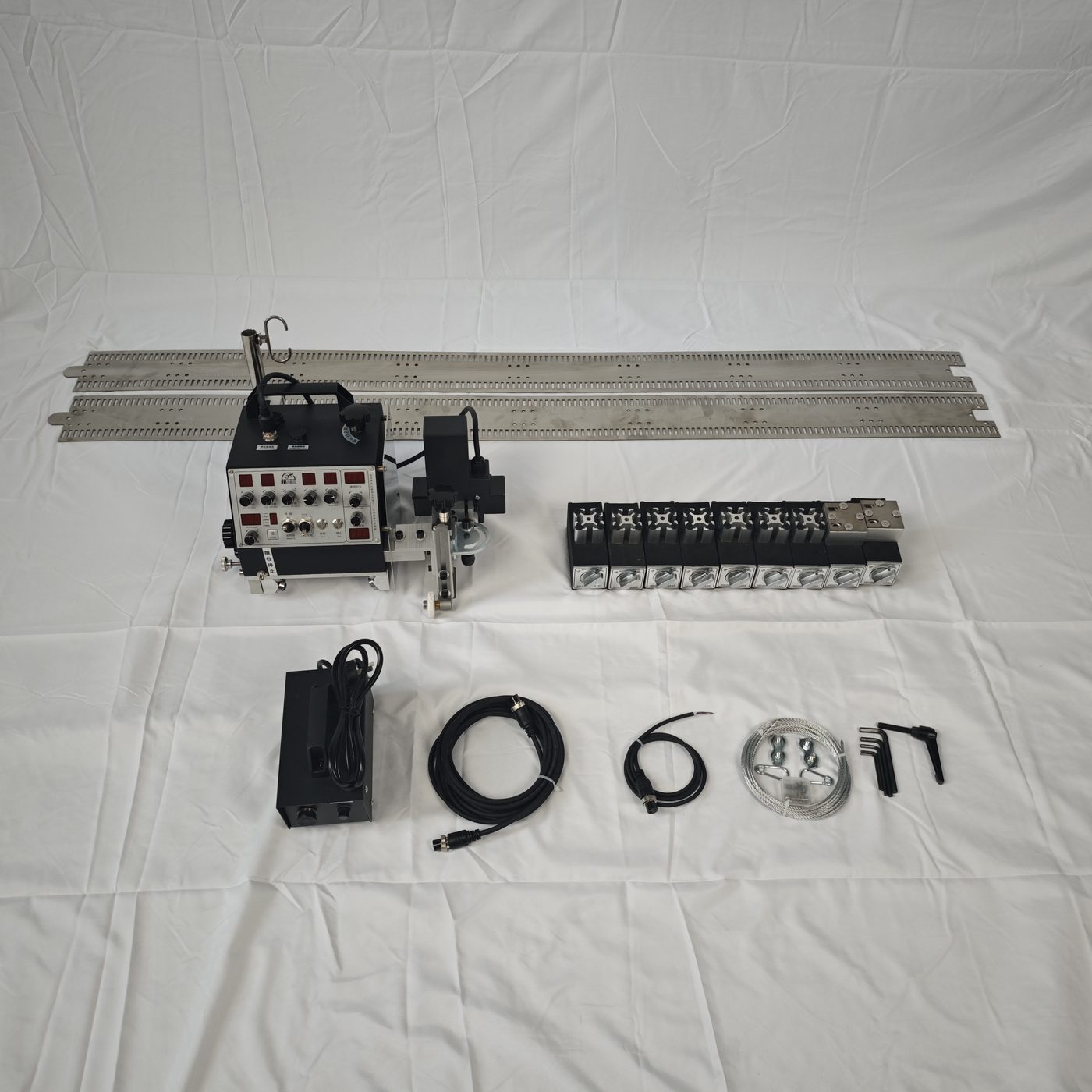
Actual kit photo — integrated C-type (magnetic) standard configuration.
| Item | Specification |
|---|---|
| Carriage model | RG-III-Q1/Z (straight swing) · RG-III-Q1/J (angle swing) |
| Drive mode | Chain-sprocket drive (main unit travel) |
| Welding speed | 0–1100 mm/min (digital display) |
| Minimum workpiece diameter | Ø1800 mm and above (magnetically permeable material) |
| Minimum suction thickness | 3 mm |
| Carriage dimensions (L×W×H) | RG-III-Q1/Z: 240 × 365 × 302 mm · RG-III-Q1/J: 260 × 503 × 302 mm |
| Carriage weight | 8.7 kg |
| Swing mode | Straight swing (Z) / angle swing (J) |
| Swing width | 0–32 mm (digital, simulated value) |
| Swing angle | 30° (angle-swing version) |
| Swing speed | 0–2700 mm/min |
| Dwell time left / right | 0–4 s each |
| Centre offset compensation | ±5 mm |
| Torch adjustment — vertical | 65 mm (vertical slide) |
| Torch adjustment — horizontal | 90 mm (magnetic type /C) · 85 mm (clamping /B and suction /X) |
| Oscillator rotation | ±60° (oscillator can be rotated) |
| Torch nozzle travel angle | ±25° |
| Weave forms (welding forms) | 5 built in — straight line · trapezoidal · positive sawtooth · castellated (Great Wall) · diagonal sawtooth |
| Intermittent (stitch) welding | Welding time 0–99.9 s · gap time 0–99.9 s (knob; long-press 2 s to unlock) |
| Parameter memory | Last settings restored automatically after power-off |
| Limit switches | ×2 — stops welding automatically at the set position |
| Main unit power | 96 W |
| Ambient conditions | −20 to +60 °C · 0–90 % relative humidity |
| Flexible track belt | Custom stainless steel, 1784 × 102 × 2 mm, 2 kg per rail; high hardness, high elasticity, self-recovering flatness |
| Magnetic block (type /C) | V-type 12 T metal-handle magnetic base, 120 × 50 × 55 mm, 2 kg each, holding force 35 kg per block (room temperature, thick plate, vertical) |
| Suction cup (type /X) | Silicone, rated above 250 °C, 150 kg ideal hold per cup; vacuum pump to −93 kPa (start 0.4 kgf · stop 0.85 kgf) |
| Tensioner (type /B) | Automatic-contraction type, 300–6000 mm effective length, 2 t tensile resistance |
| Track assembly weight | /C 10 kg · /B 4.2 kg · /X 4 kg per rail; quick-plug joint, roughly 15–20 s to mount one rail |
| Standard configuration | Carriage ×1 · flexible tracks ×2 · Power unit ×1 · Power cable ×1 · Two-pin ignition lead ×1 · Tool kit ×1 · Documents ×1 · Packaging ×1 |
| Packing | Foam packing 1850 × 140 × 30 mm, 5 kg (holds 2 track rails) · Wooden case 510 × 410 × 420 mm — 40 kg (/C) · 23 kg (/B) · 22 kg (/X) |
Full technical data for this machine in a printable English PDF — specifications, configuration and options. Hand it to your engineering team.
Download Datasheet (PDF)Values are taken from the product operation manual. Custom configurations — track length, track variant, torch fixture and supply voltage — are quoted to your workpiece.
Naming guide: RG-III-Q1 = flexible-track magnetic · RG-III-Q1/Z-B, /J-B = clamping type · "Z" = straight swing, "J" = angle swing · first letter uppercase = integrated type, lowercase = split type.
How to choose the fixing: "/C" magnetic — carbon steel tanks from ∅1800 mm, welding inside and outside the shell; the usual choice. "/X" vacuum-suction — stainless and other non-magnetic shells; silicone cups hold 150 kg each. "/B" clamping — the track is clamped around an annular workpiece by a 2 t tensioner (300–6000 mm effective length), for shells where neither magnetism nor suction is reliable.
| Model | Track | Type | Swing |
|---|---|---|---|
| RG-III-Q1/Z-C | Magnetic | Integrated | Straight swing |
| RG-III-Q1/J-C | Magnetic | Integrated | Angle swing |
| Rg-III-Q1/Z-C | Magnetic | Split | Straight swing |
| Rg-III-Q1/J-C | Magnetic | Split | Angle swing |
| RG-III-Q1/Z-X | Suction | Integrated | Straight swing |
| RG-III-Q1/J-X | Suction | Integrated | Angle swing |
| Rg-III-Q1/Z-X | Suction | Split | Straight swing |
| Rg-III-Q1/J-X | Suction | Split | Angle swing |
| RG-III-Q1/Z-B | Clamping | Integrated | Straight swing |
| RG-III-Q1/J-B | Clamping | Integrated | Angle swing |
| Rg-III-Q1/Z-B | Clamping | Split | Straight swing |
| Rg-III-Q1/J-B | Clamping | Split | Angle swing |
Every Little Gecko carriage drives a wire-fed MIG/MAG torch. Bring any MIG/MAG power source, torch, wire feeder and wire that supports the process — the carriage takes over travel, oscillation and the trigger. Stick (SMAW) electrodes are not supported: a consumable electrode that shortens as it melts cannot be fed at a constant rate, so there is no way to automate it. Wire makes automation possible.
What you get: the carriage, oscillator, flexible track and control box. What is not included: welding machine, torch, wire feeder, welding wire and gas — you use your own. The carriage connects to your power source and wire feeder through a two-pin ignition control lead, and the universal torch fixture takes Ø18–25 mm torches (200–500 A). One setting to check first: switch off the arc-termination (crater) function on your welder, otherwise the weld will not stop at the end of the seam.
The carriage, oscillator and controller are the same. What changes is how the flexible track is held onto the workpiece — and that decides which shells the machine can be used on.
| Track type | Held by | Workpiece | Track weight | Usually chosen for |
|---|---|---|---|---|
| Type /C — magnetic RG-III-Q1/Z-C · /J-C |
V-type 12 T magnetic bases, 35 kg hold each (room temperature, thick plate, vertical) | Carbon steel from ∅1800 mm — inside and outside the shell | 10 kg per rail | Most tank and pressure-vessel work on magnetically permeable plate |
| Type /X — vacuum suction RG-III-Q1/Z-X · /J-X |
Silicone suction cups, 150 kg ideal hold each, vacuum pump down to −93 kPa | Stainless steel and other non-magnetic shells; needs a reasonably regular surface | 4 kg per rail | Stainless vessels where magnets cannot hold |
| Type /B — clamping RG-III-Q1/Z-B · /J-B |
Automatic-contraction tensioner, 300–6000 mm effective length, 2 t tensile resistance | The track is clamped around an annular workpiece by tension alone | 4.2 kg per rail | Circumferential work where neither magnetism nor suction is dependable |
Do not let a non-magnetic layer sit between the track and the steel: insulation, anti-corrosion cloth or paint of that kind stops the magnetic type from holding. For stainless shells and for insulated or coated pipe, choose the /X suction or /B clamping track instead. If in doubt, tell us the material and the minimum wall thickness and we will confirm the track type before you order.
Machines are specified by weld type and workpiece, not by catalogue page. See how this series is used in real fabrication work:
Tell us the diameter and plate thickness — we'll confirm the right track type and send you a direct quotation.