Fully automatic tube-to-tubesheet welding for boilers, heat exchangers, condensers and coolers. Applicable tube inner diameter 25–108 mm, with expanding heads customized to your tube size.
Also known as: tube sheet welding machine, tube-to-tubesheet welding machine, boiler tube welding machine.
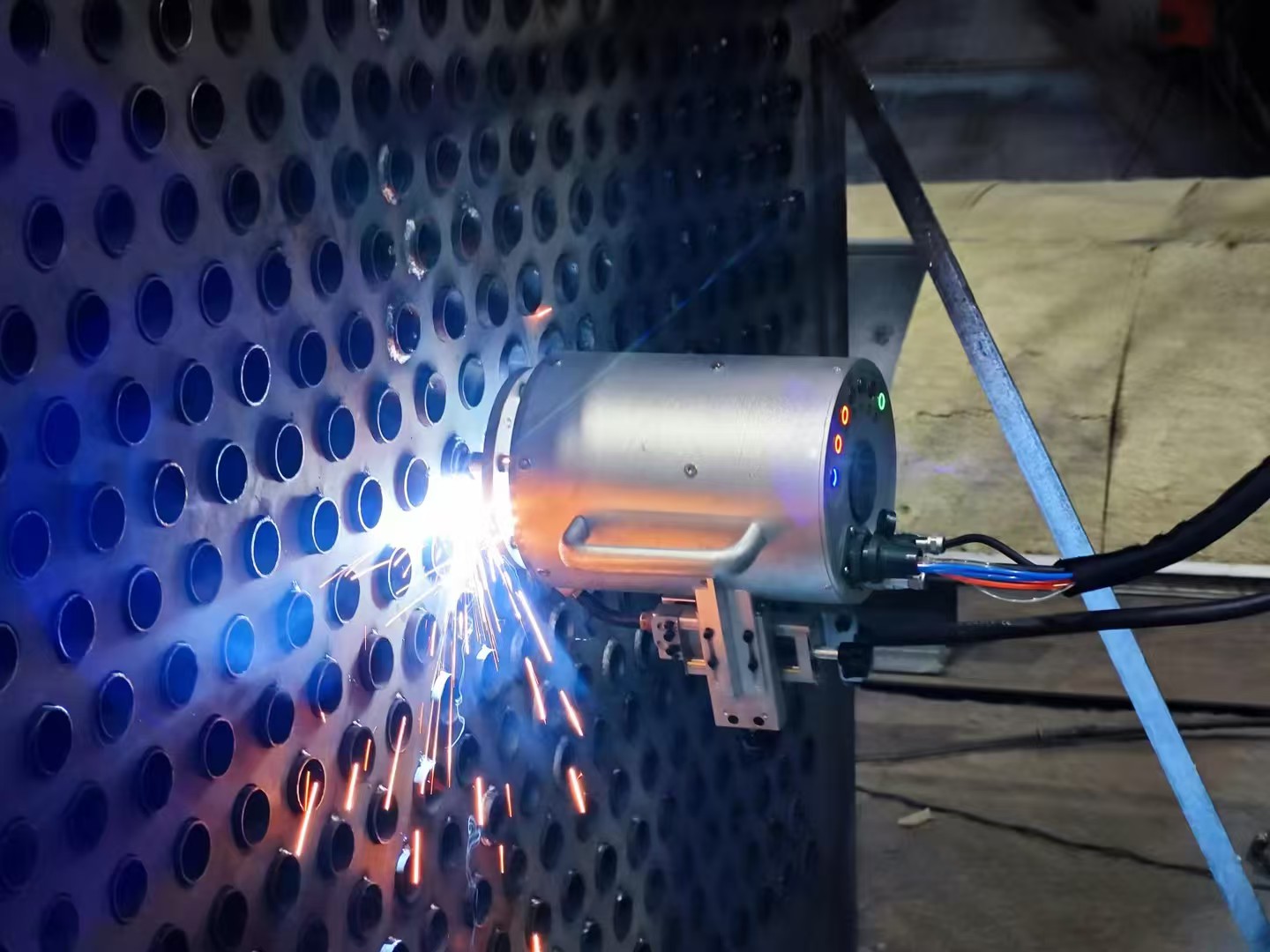
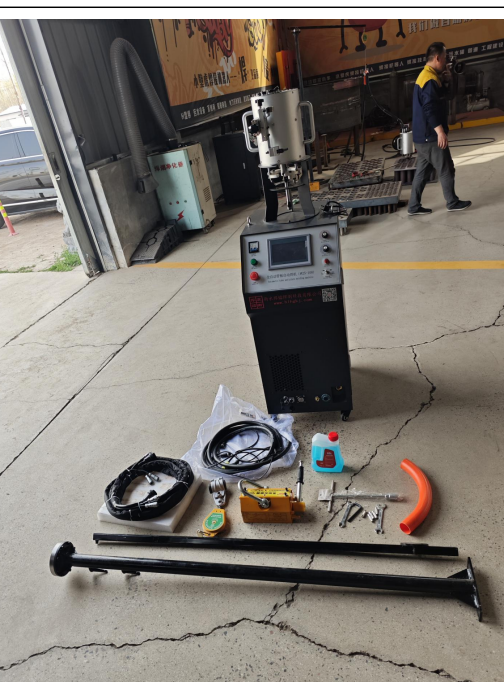
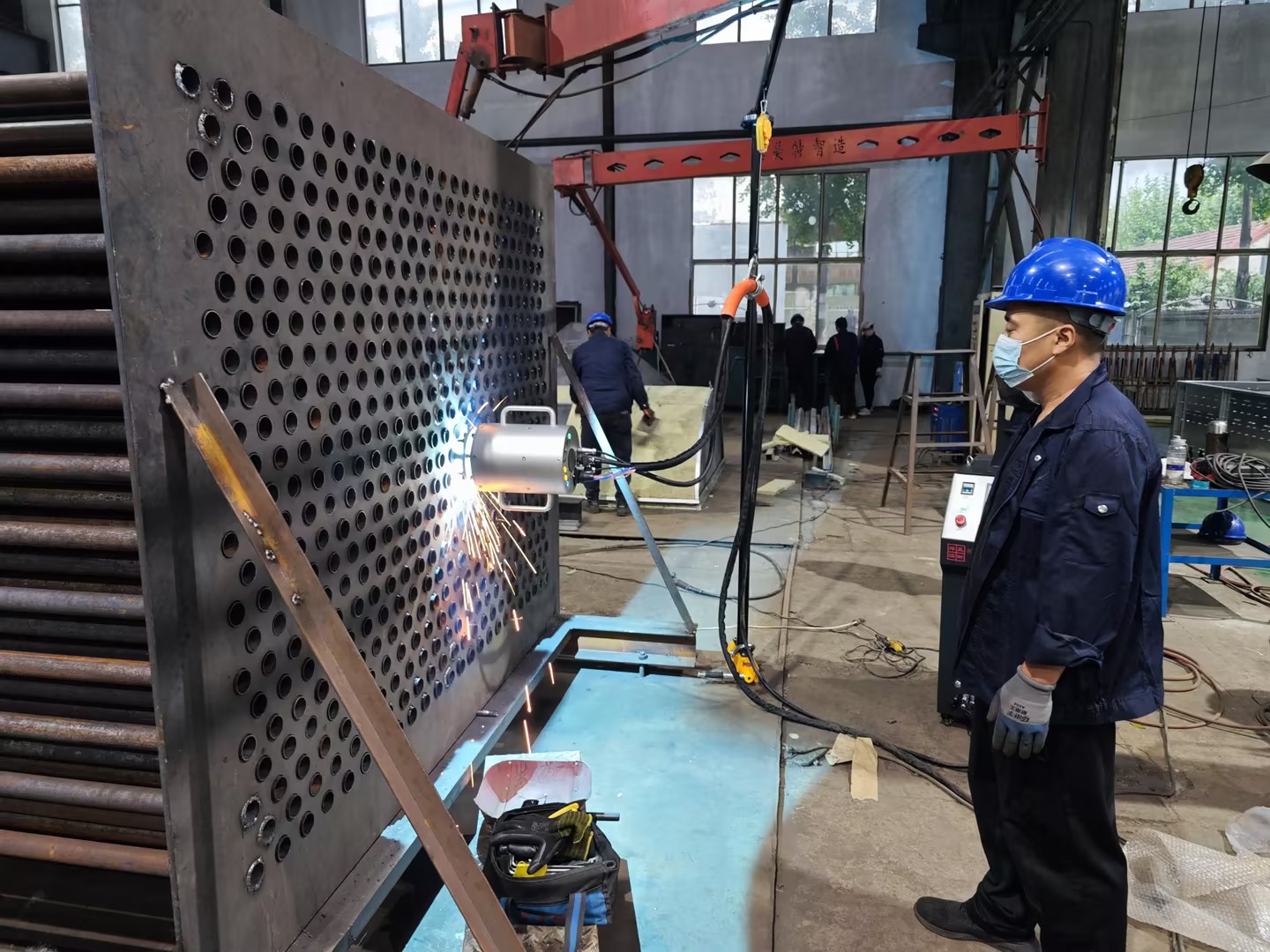
Position the welding head on the tube, and the HLGB25-108 completes the tube-to-tubesheet joint automatically — consistent penetration and bead appearance across the whole tubesheet, tubesheet after tubesheet.
Tube-to-tubesheet welding is the same joint repeated hundreds of times on one sheet. Doing it by hand means the result depends on how steady the welder's hand still is at joint 300. This machine removes that variable: the head centres itself in the bore, and the same parameter set is applied to every hole.
The operator places the welding head on the tube end. The expanding head is made to your tube gauge, so it fits the bore rather than being adjusted to it — alignment does not depend on how steady a hand is holding it.
The pneumatic expanding head clamps inside the tube and holds the welding head concentric with it. Tubes run from 25–108 mm inner diameter, with 5–20 mm of tube protruding above the tubesheet for the fillet (outside corner) weld.
The spindle rotates a full 360° plus an overlap angle and the joint is finished — a maximum of 16.7 seconds per revolution, roughly twice the output of manual welding in our production comparisons. For horizontal tubes, double half-circle mode turns two half-circles so neither half is welded in an awkward position. Mode is switched from the touch screen.
Move the head to the next tube and start the cycle again. Because both the centring and the parameter set repeat, joint 180 looks like joint 1 — and that is what removes the rework that manual tubesheet welding generates.
Tell us the tube outside diameter, wall thickness, material and how far the tubes protrude above the sheet. We will confirm the expanding head and the starting parameter set before you order.
Send Your Tube DetailsThe joint is the same every time; what changes is how much of the result depends on the person holding the torch.
| Route | Equipment | Consistency across the tubesheet | Operator dependence | Best for |
|---|---|---|---|---|
| Manual stick (SMAW) | Stick welder, one joint at a time | Varies from joint to joint with the welder | Entirely dependent on operator skill and fatigue | Small one-off work and repairs |
| Manual TIG (GTAW) | TIG set, one joint at a time | Good, but hard to hold over hundreds of near-identical joints | High — the whole sheet depends on one pair of hands | Low-volume or code-critical small sheets |
| Automatic tube-to-tubesheet machine (HLGB25-108) | This machine, running on your MIG/MAG or FCAW power source | Same parameter set on every joint — joint 180 looks like joint 1 | The head centres itself in the bore; one operator works head to head all shift | Production tubesheets on boilers, heat exchangers and condensers |
Not tube joints at all? If you are welding shell seams, drum longitudinal seams or tank plate, you need a carriage rather than this machine — see the straight-rail carriage, the flexible-track carriage or the magnetic crawler, or answer a few questions in the selection guide.
The HLGB25-108 runs the MIG/MAG (GMAW) wire process and also FCAW flux-cored wire, on your existing MIG/MAG or FCAW power source — no need to change brand. Stick (SMAW) electrodes cannot be automated: a stick electrode is itself the consumable and shortens as it melts, so it cannot be fed to the arc at a constant rate, which is exactly what an automatic cycle requires. Wire, fed at a set speed, can be.
What you supply: the MIG/MAG or FCAW welding power source, the welding wire and the shielding gas. What the machine brings: the welding head, the control cabinet with integrated wire feeder, water cooling and air compressor, and a dedicated 350 A torch — so there is no torch or wire feeder to buy on top. Welding current and voltage are set from the control cabinet panel and stay synchronised with your power source. Not sure your power source is compatible? Send us the model and we will confirm before you order.
| Item | Specification |
|---|---|
| Model | HLGB25-108 |
| External power supply | AC 220 V, 50/60 Hz (±10 %) |
| Drive voltage | AC 220 V (motor power) |
| Control voltage | DC 24 V |
| Ambient temperature | -20 to +60 °C (dry-bulb) |
| Ambient humidity | 0–90 % (relative) |
| Drive mode | Servo motor drive, spindle rotation with pneumatic expanding head |
| Working mode | Double half-circle (horizontal tube) / full circle (vertical tube) |
| Maximum welding speed | 16.7 s per revolution |
| Applicable tube inner diameter | Ø25–108 mm |
| Expanding-head clamping range | 3 mm (tube diameter range) |
| Tube protrusion above tubesheet | 5–20 mm (fillet / outside corner weld) |
| Torch adjustment range | Vertical 60 mm (vertical slide) · Radial 50 mm (tube welding radius adjustment) |
| Rotation speed | 0–1300 (touch-screen setting, simulated value) |
| Welding delay | 0.0–99.0 s (touch-screen setting) |
| Arc-out delay | 0.0–99.0 s (touch-screen setting) |
| Wire retract time | 0.0–99.0 s (touch-screen setting) |
| Positioning cylinder delay | 0.0–99.0 s (touch-screen setting) |
| Production counter | 0–99999 pieces, display / reset |
| Manual / automatic wire feed | Jog wire feed (manual) / computer-controlled feed (automatic) |
| Weld type | Fillet (outside corner) tube-to-tubesheet joints; torch travels without oscillation |
| Carriage dimensions (L×W×H) | 360 × 330 × 430 mm, 15 kg (main unit) |
| Control cabinet dimensions | 650 × 450 × 950 mm, 70 kg; integrated air compressor, wire feeder and water-cooling system; lifting rings and castors |
| Connection cable bundle | 5 m total length, aviation plugs with anti-misplug design, textile protective sleeve |
| Dedicated torch | Model 350 A, 5 m cable |
| Connection to your power source | 6-core control cable from the control cabinet to your existing MIG/MAG power source (Panasonic-type port); welding current and voltage are adjusted on the cabinet panel and stay synchronised with the power source |
| Wireless foot pedal | Included — wireless transmitter plus receiver inside the control cabinet; replaces manual clamping for double-spaced tubesheet patterns where the operator cannot reach the machine |
| Pneumatic systems | Positioning cylinder (centres the head in the bore) and expanding/tensioning cylinder (locks the head to the tube wall); both operated from the panel or the foot pedal |
| Cable suspension bracket | Magnetic base, 1500 mm working radius, 600 kg ideal pull-off force |
| Standard configuration | Main unit ×1 · Control cabinet ×1 · Integrated cable bundle ×1 · Dedicated torch ×1 · Wireless foot pedal ×1 · Cable suspension bracket ×1 · Tool kit ×1 · Documents ×1 · Packaging ×1 |
| Packing | Wooden case 820 × 620 × 1720 mm, 140 kg total |
Full technical data for this machine in a printable English PDF — specifications, configuration and options. Hand it to your engineering team.
Download Datasheet (PDF)Values are taken from the product operation manual. Custom configurations — track length, torch fixture, dual-torch setup, expanding-head size — are quoted to your workpiece.
Tell us your tube inner diameter, wall thickness and material — we will configure the matching expanding head and quote factory-direct.
Machines are specified by weld type and workpiece, not by catalogue page. See how this series is used in real fabrication work:
Send us the tube inner diameter and material — we'll configure the right expanding head and send a quotation within 24 hours.