Both machines exist to replace the human hand moving the weld. The difference is which half stays still. Pick wrong and you either buy a positioner that cannot lift your workpiece, or a carriage that has nothing to grip on.
A welding carriage rides on the workpiece (or a track fixed to it) and carries the torch along the joint. The workpiece never moves. That makes it the tool for parts that are too big, too heavy or too awkward to rotate: tank shells in place, ship panels, box beams several metres long.
A welding positioner does the opposite: it clamps the workpiece — usually near its centre of gravity — and rotates or tilts it under a stationary torch. The seam is fed to the arc. That is the tool for parts you can lift: flanges, nozzles, pipe fittings, small vessels.
The selection question is brutally practical: can you lift and clamp the part? If yes, a positioner often wins on cycle time. If no, the carriage is the only option.
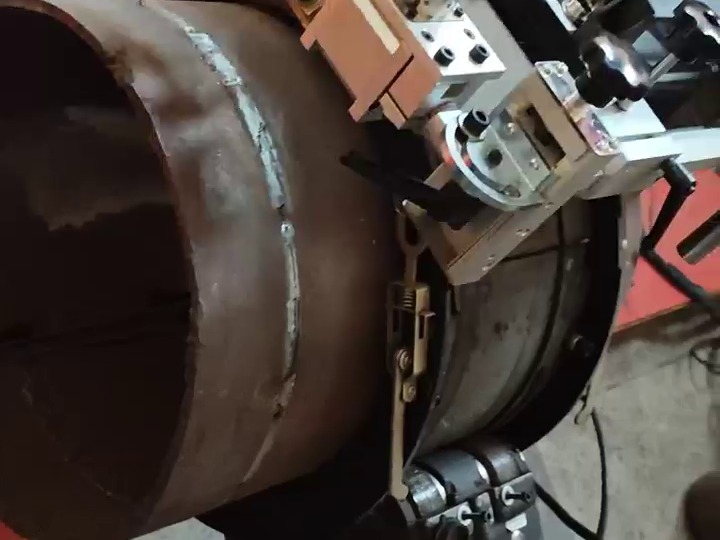
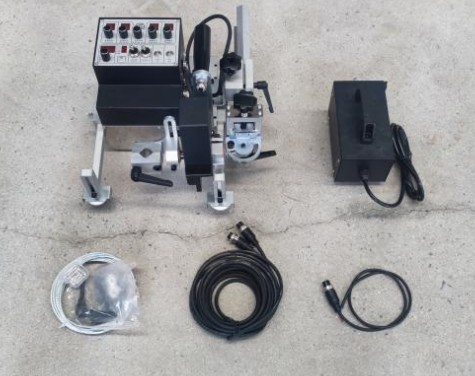
Seven real jobs, including the ones where the honest answer is “neither — keep it manual”.
| Job | Welding carriage | Welding positioner | Why |
|---|---|---|---|
| Tank shells, already welded or in place | Best fit | Impossible | You cannot clamp a finished shell to a table |
| Pipe spools under 2 m, loose | Possible (crawler, Ø108+) | Best fit | On a positioner the seam spins to the torch — zero rigging |
| Long straight panel seams (several m) | Best fit | Not practical | Table would have to be as long as the panel |
| Nozzle and flange welds on small vessels | Awkward | Best fit | Rotate the part, hold the torch still, one pass per joint |
| H-beam / box-beam fillet welds | Best fit (JJ/GJ corner carriage) | No | The machine rides the corner itself; a positioner cannot present a 12 m beam corner |
| Field erection sites | Only option | No | Nothing to stand a positioner on |
| Big vessels, both seams needed | Carriage or crawler | Turning rolls | The standard shop solution is rolls + automated torch travel — both halves |
Money angle: a positioner's cost scales with payload — a 5 t table costs multiples of a 1 t table. A carriage's cost barely changes whether the part weighs 50 kg or 5 t. For heavy fabrication the carriage is almost always the cheaper automation per metre of seam.
A photo of the workpiece and its rough weight is enough for us to tell you honestly which side of this comparison your job falls on.