No track needed — rubber-wheel (JJ) and magnetic steel-wheel (GJ) models walk directly along the corner joint. Dual-torch models carry two torches on one carriage, both with their own control panel, and weld two fillets of a box section in one pass across a 400–800 mm working width.
Also known as: fillet welding carriage, corner welding tractor, automatic fillet welding machine.
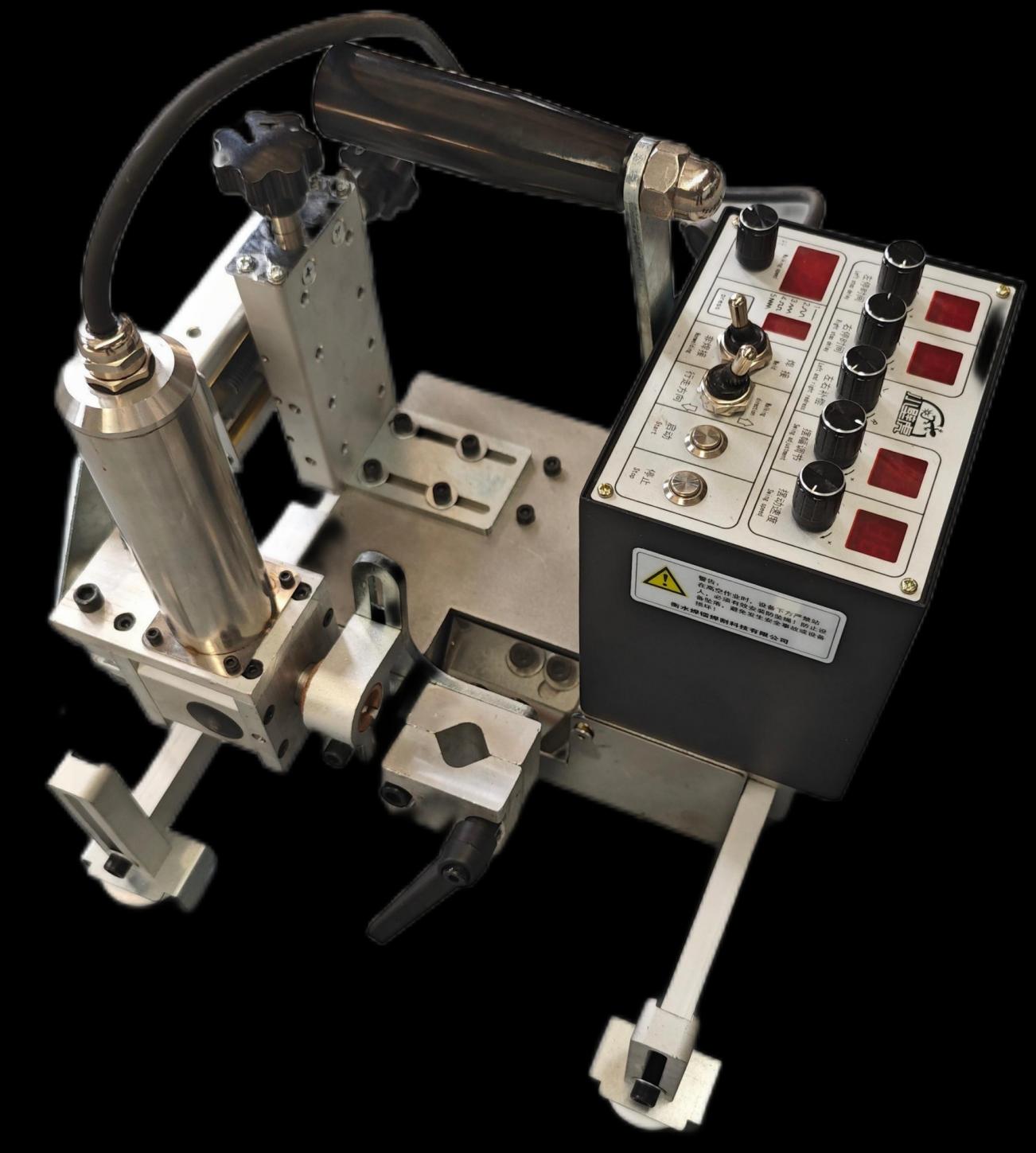
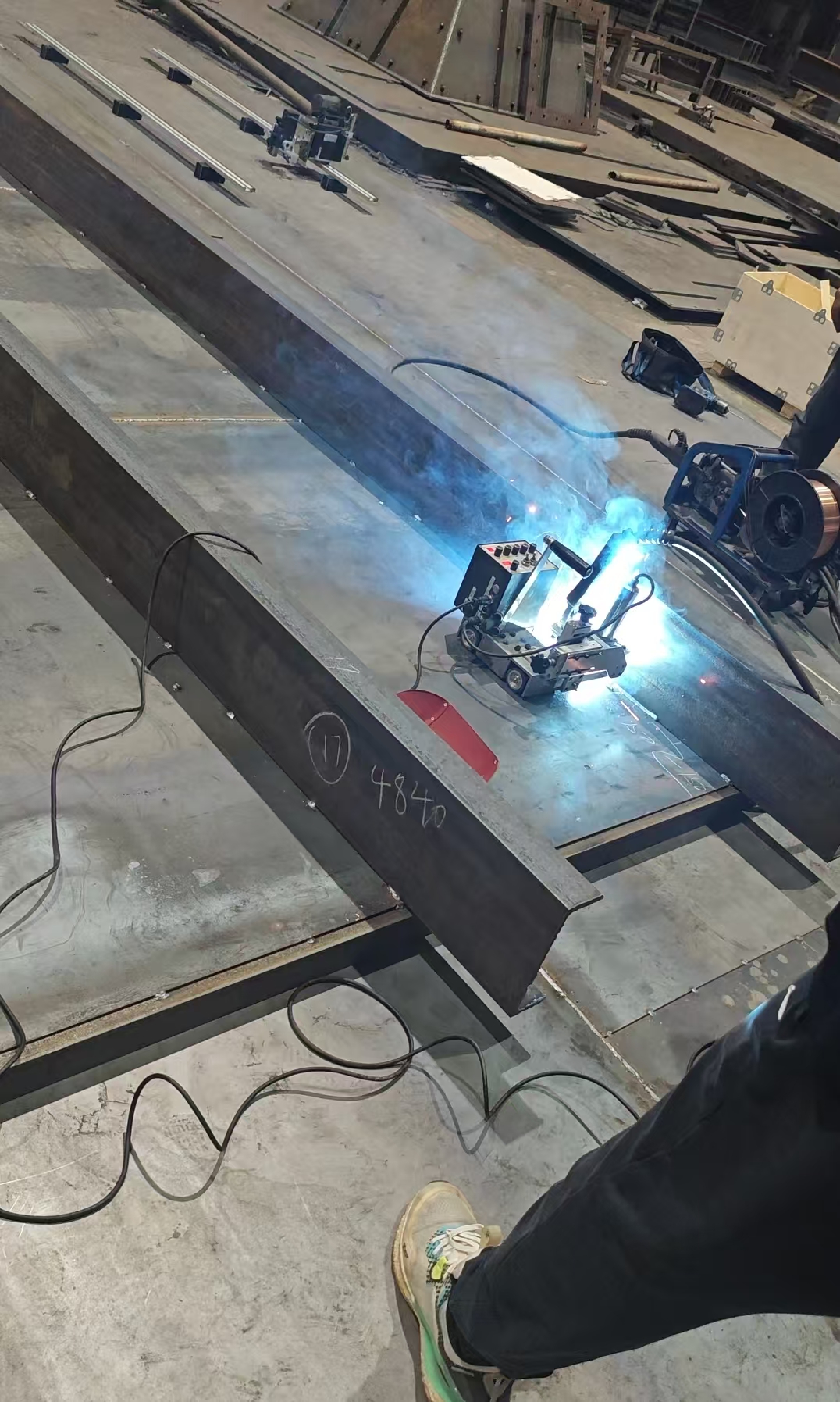
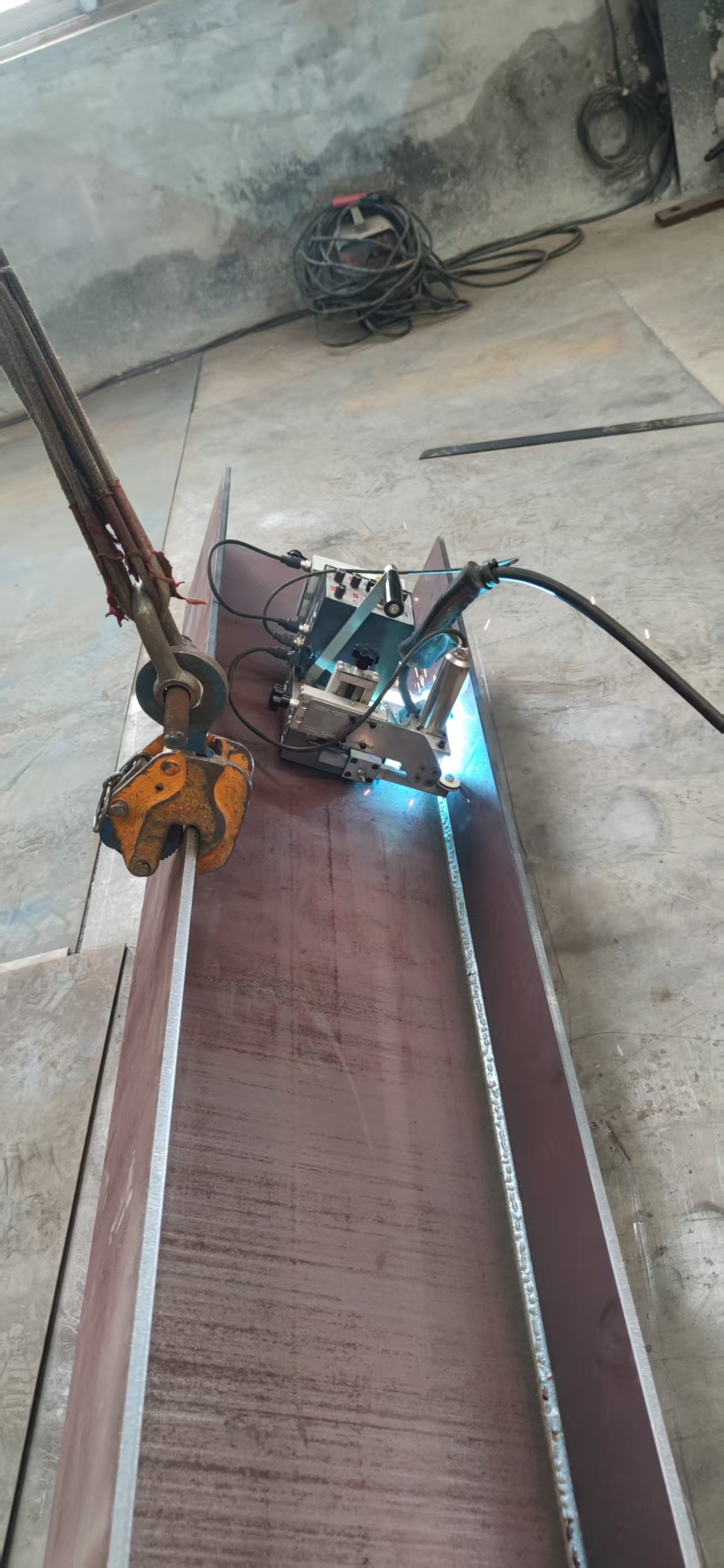
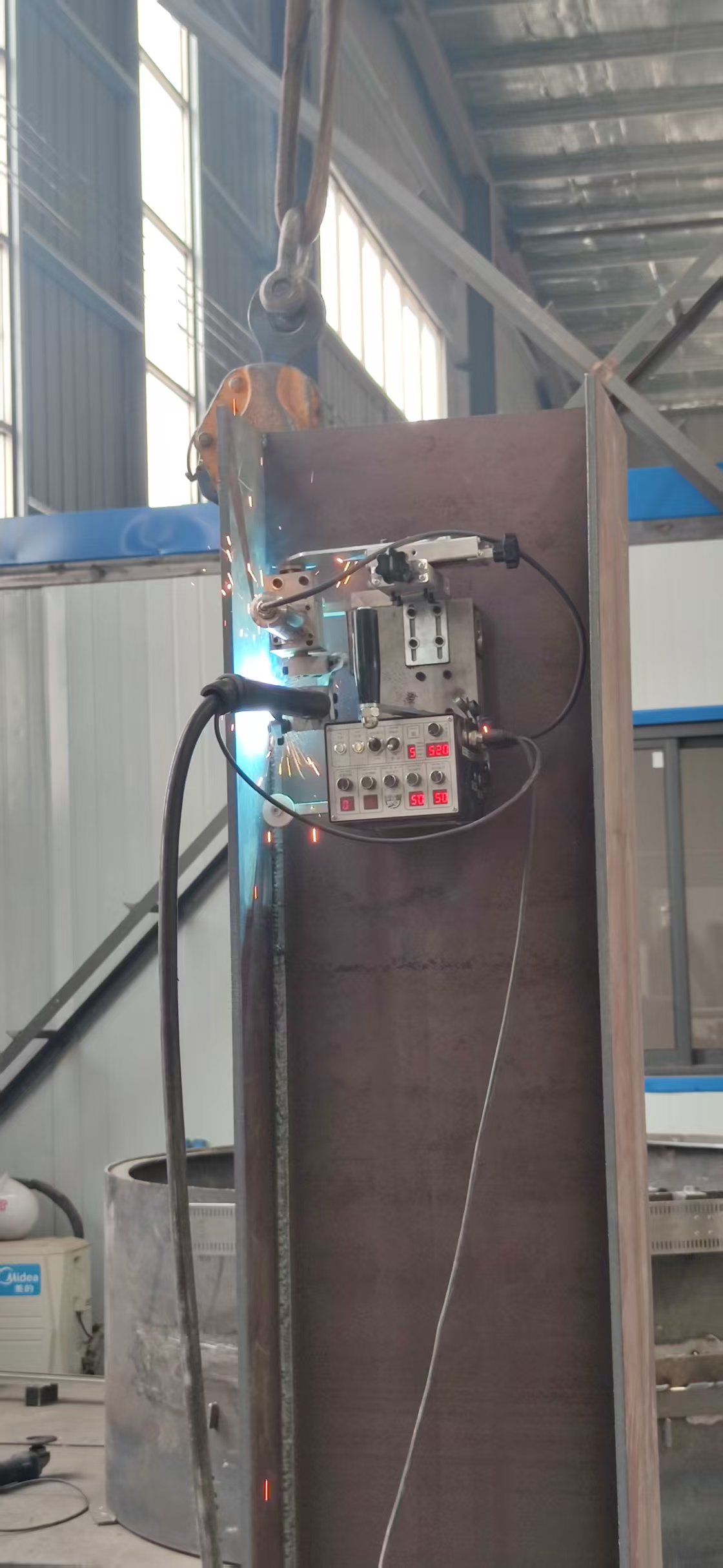
Made for steel structure fabrication: H-beams, box beams and welded frames. The carriage walks the corner joint directly — no track needed — and the dual-torch model straddles a box section, welding two fillets at once over a 400–800 mm working width.
A fillet welding carriage does not need a track run along the beam. Rubber wheels with internal permanent magnets (JJ) or magnetic steel wheels (GJ) hold the carriage against the workpiece, and it drives itself along the corner joint. Set travel speed, swing angle and dwell once on the Gen-III controller, and the same leg length repeats down the whole beam.
There is no track to lay along an H-beam or a box section. The carriage rides the corner joint directly — rubber-wheel (JJ) or magnetic steel-wheel (GJ) drive — and travels at 0–990 mm/min, with the speed shown on a digital display. Minimum suction thickness is 4 mm of magnetically permeable material.
The dual-torch model straddles a box section with one torch on each side and welds both fillets at the same time — the working width range is 400 to 800 mm. Each torch has its own control panel, so the two sides can be set to different parameters, which is what you want when the two joints are not identical. Note: the dual-torch model is for flat (horizontal) welding only — it does not weld in other positions.
The angle oscillator sweeps the torch across the fillet: 0–30° swing angle, 0–32 mm swing width, 0–2700 mm/min swing speed, with left and right dwell set independently. Five weave patterns are built in — straight line, trapezoid, sawtooth, castellated and oblique sawtooth — so you can pick the bead profile that suits the joint. The oscillator rotates ±60° and the angle oscillator carries a 360° centre-offset adjustment for a joint that wanders. Single-torch models also support intermittent welding.
Because travel, oscillation and the wire feed are each set independently, leg length and penetration come out identical from the first beam to the hundredth — which is what removes the rework that hand-welded fillets generate on a long run.
It comes down to the workpiece surface and the welding position. Send us a photo of the joint and tell us the leg length you need — we will confirm which drive and how many torches suit it.
Send a Photo, Get an AnswerOne decision decides most of the value: whether the carriage welds one fillet at a time, or both fillets of a box section in a single pass.
| Configuration | Torches | Working width | Position | Carriage weight | Best for |
|---|---|---|---|---|---|
| Single-torch carriage JJ-III-Q1 / GJ-III-Q1 |
1 | Any fillet the torch can reach | Flat, vertical and overhead | 9.2 kg | Mixed work, short runs, jobs that need stitch welds; the lightest machine to reposition |
| Dual-torch carriage JJ-III-Q2 / GJ-III-Q2 |
2, each with its own control panel | 400–800 mm across the workpiece | Flat (horizontal) welding only | 13 kg | Steel-structure box sections and long beams — both fillets welded in one pass |
The 400–800 mm figure is the working width the dual-torch carriage straddles — not the leg length of a single weld. The two torches sit on opposite sides of a box section and each runs its own parameter set. One pass does what used to take two setups.
Drive is a separate choice: JJ (rubber wheels with internal permanent magnets) or GJ (magnetic steel wheels). Which one suits you depends on the workpiece surface and the welding position — send us the joint and we will confirm. Fillet welds on long flat plate rather than on a beam corner are usually better served by a straight-rail carriage or a flexible-track carriage, or answer a few questions in the selection guide.
Every Little Gecko carriage drives a wire-fed MIG/MAG torch. Bring any MIG/MAG power source, torch, wire feeder and wire that supports the process — the carriage takes over travel, oscillation and the trigger. Stick (SMAW) electrodes are not supported: a consumable electrode that shortens as it melts cannot be fed at a constant rate, so there is no way to automate it. Wire makes automation possible.
What you get: the carriage, oscillator, track and control box. What is not included: welding machine, torch, wire feeder, welding wire and gas — you use your own. The carriage connects to your power source and wire feeder through a two-pin ignition control lead, and the universal torch fixture takes Ø18–25 mm torches (200–500 A). Not sure your machine fits? Send us the model and we will confirm before you order.
| Item | Specification |
|---|---|
| Carriage model | JJ-III-Q1/J (angle swing, single torch, trackless) · JJ-III-Q2/J (angle swing, dual torch, trackless) |
| Drive mode | Rubber-wheel drive with internal permanent magnets |
| Welding speed | 0–990 mm/min (digital display) |
| Minimum suction thickness | 4 mm (magnetically permeable material) |
| Minimum curved-surface radius | 1500 mm outer radius (≈3000 mm diameter) · 1450 mm inner radius (≈2900 mm diameter) |
| Carriage dimensions (L×W×H) | 308 × 260 × 288 mm (single torch) · 442 × 850 × 288 mm (dual torch) |
| Carriage weight | 9.2 kg (single torch) · 13 kg (dual torch) |
| Swing mode | Angle swing |
| Swing angle | 0–30° (digital, simulated value) |
| Swing speed | 0–2700 mm/min |
| Weave patterns | 5 selectable forms — straight line, trapezoid, sawtooth, castellated and oblique sawtooth |
| Dwell time left / right | 0–4 s each |
| Centre offset compensation | 360° rotation adjustment on the angle oscillator |
| Torch adjustment — vertical | 65 mm (vertical slide) |
| Torch adjustment — horizontal | 140 mm (main unit left/right rail) |
| Oscillator rotation | ±60° |
| Torch nozzle travel angle | ±25° |
| Power supply | External AC 110–220 V, 50/60 Hz (±10 %) · working voltage DC 24 V |
| Ambient conditions | −20 to +60 °C (dry bulb) · 0–90 % relative humidity |
| Magnet wheel tolerance | Permanent magnets keep full strength below 300 °C; the magnet arrangement does not affect the weld |
| Parameter memory | Last operation data is stored — settings are restored automatically after power-off |
| Dual-torch working width | 400–800 mm across the workpiece (min. 400 mm · max. 800 mm), measured between the two torches |
| Dual-torch welding position | Flat (horizontal) welding only — the dual-torch model is not used in other positions |
| Standard configuration | Carriage ×1 · Gen-III power unit ×1 · Gen-III angle oscillator · Two-axis adjustment assembly · Universal torch fixture ×1 · Tool kit ×1 · Documents ×1 · Packaging ×1 (dual-torch model: oscillator and torch fixture ×2, dual control panels) |
Full technical data for this machine in a printable English PDF — specifications, configuration and options. Hand it to your engineering team.
Download Datasheet (PDF)Values are taken from the product operation manual. Custom configurations — track length, torch fixture, dual-torch setup, expanding-head size — are quoted to your workpiece.
Naming guide: JJ-III-Q1 = rubber-wheel corner welding · GJ-III-Q1 = steel-wheel corner welding · "Z-W" = straight swing, "J-W" = angle swing · Q2 = dual-torch version · "/W-W" = non-oscillating entry model with fixed torch.
CZ-III-Q1/J-W side-mount version carries the torch beside the carriage body — it reaches corner joints where the carriage cannot sit directly over the seam.
| Model | Drive | Torch | Swing |
|---|---|---|---|
| JJ-III-Q1/Z-W | Rubber wheel | Single | Straight swing |
| JJ-III-Q1/J-W | Rubber wheel | Single | Angle swing |
| JJ-III-Q2/J-W | Rubber wheel | Dual | Angle swing |
| JJ-III-Q1/W-W | Rubber wheel | Single | No swing (fixed torch) |
| CZ-III-Q1/J-W | Rubber wheel · side-mount | Single | Angle swing |
| GJ-III-Q1/Z-W | Magnetic wheel | Single | Straight swing |
| GJ-III-Q1/J-W | Magnetic wheel | Single | Angle swing |
| GJ-III-Q2/J-W | Magnetic wheel | Dual | Angle swing |
Machines are specified by weld type and workpiece, not by catalogue page. See how this series is used in real fabrication work:
Tell us the fillet size and welding position — we'll match you to the right JJ or GJ model.