This is the single most common question in first-time enquiries — and the honest answer is no. A welding carriage is the automation unit, not a welder. Here is exactly what arrives in the crate, what you supply yourself, and how the two sides talk to each other.
A welding carriage automates three things: moving the torch at a constant speed along the seam, oscillating it across the joint, and triggering your welder at the right moment. It does not generate arc, it does not feed wire, and it does not hold gas.
That is why the machine is far cheaper than it looks next to a full welding plant: the expensive parts of the system — power source, wire feeder, torch, gas equipment — are already in your shop. The carriage plugs into them.
Every Little Gecko carriage works this way. The III-generation controller takes over the trigger of your existing MIG/MAG power source through a two-pin ignition control lead; nothing in your welder is modified.
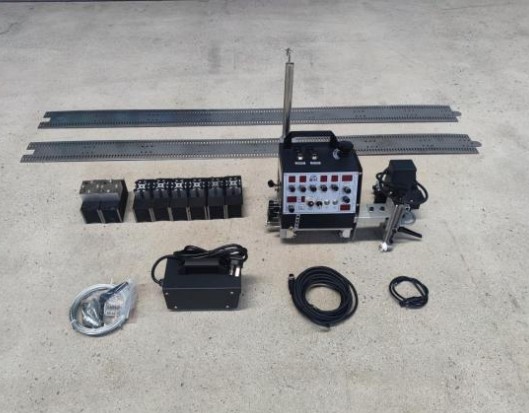
Print this table and hold it against any quotation you receive — ours or a competitor's. If a price looks too good, check which column is missing.
| Part of the system | Included with the carriage | You supply (or request as options) |
|---|---|---|
| Arc & wire | Not included | MIG/MAG power source, wire feeder, welding torch |
| Shielding gas | Not included | Gas bottle, regulator, flow meter, hoses |
| Travel along the seam | Included — carriage + track | — |
| Oscillation (weave) | Included — 0–32 mm, 0–2700 mm/min | — |
| Trigger control | Included — two-pin ignition lead | Trigger socket on your welder (standard on MIG/MAG) |
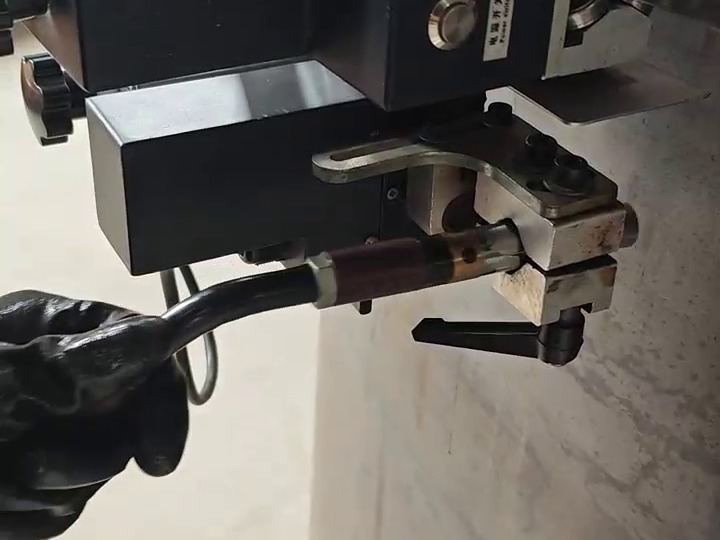
| Torch holding & angle | Included — universal fixture, Ø18–25 mm | The torch itself |
| Setup & parameter support | Included — we help match your wire, gas and speed | Your WPS, if the job requires one |
One warning for comparing suppliers: some brands sell an integrated welding tractor with built-in feeder. It is a different product category — heavier, pricier, and it locks you to their consumables. A carriage + your own welder is the flexible route.
A typical first commissioning with our engineers on WhatsApp video takes under an hour. Alone, plan half a morning including trial welds.
Any MIG torch with an Ø18–25 mm shank fits — that covers the common 200 A to 500 A torches. Adjust height 65 mm and side shift 90 mm by knob.
Magnetic rails snap onto clean steel from 3 mm thick; suction cups for stainless and aluminium. Rail joints connect in about 10 seconds each.
One end goes to the control box, the other into your welder's trigger / remote socket. The carriage now fires the arc exactly as your foot pedal or trigger would.
Start from the wire and gas you already use. We supply starting parameters per series — travel up to 1100 mm/min on the ZG, 990 on the RG, 650 on the CX crawler.
The carriage always drives a wire-fed torch. Here is what that means for the equipment you own, and why the electrode process is out of scope.
What the carriage needs: a MIG/MAG (GMAW) power source, a torch, a wire feeder, wire and shielding gas. If your shop already runs MIG/MAG, none of that changes — the carriage bolts on top of equipment you own and trust. Any industrial brand qualifies; there is no brand lock-in and no proprietary consumable.
Why not stick electrodes (SMAW)? Automation means the machine controls the arc instead of the welder's hand. That only works when every input can be held constant — and the wire feed rate is the critical one. A stick electrode is itself the filler and the conductor: it burns down and gets shorter with every millimetre of weld. There is no way to push it into the arc at a constant, repeatable speed, so there is nothing for a carriage to regulate. Automation of electrode welding effectively does not exist in general fabrication.
Why wire changes that: with MIG/MAG the filler arrives from a spool through a feeder at a set speed, so wire feed, travel speed, voltage and current are all independent variables the machine can hold steady. That stability is what produces a uniform bead — and it is the direct reason a welding carriage can work at all.
Send the model of your power source and the job photo. We confirm compatibility before you pay for anything — and quote carriage-only or a full package, your choice.