Two welding carriages that look identical in a catalogue photo can be thousands of dollars apart, and the difference is rarely the carriage itself. Here is what moves the number, so you can compare quotes properly instead of comparing totals.
We quote per configuration, because a welding carriage is not a boxed product. The same main unit is sold with a rigid rack track, a flexible magnetic belt, a vacuum-suction track or a clamping track, and those tracks are a large part of the delivered cost.
Then come the choices that change capability: one torch or two, standard or angle-swing oscillator, single-track or dual-track, trackless fillet version versus rail-guided, plus the accessories that decide whether the machine works on your specific joint — anti-drift fixture, floating support rod, battery pack, spares kit.
Because everything is built and packed in our own workshop, we can tell you exactly which option adds what. That is the point of buying factory-direct: not a lower headline number, but a configuration that matches your seam instead of a catalogue compromise.
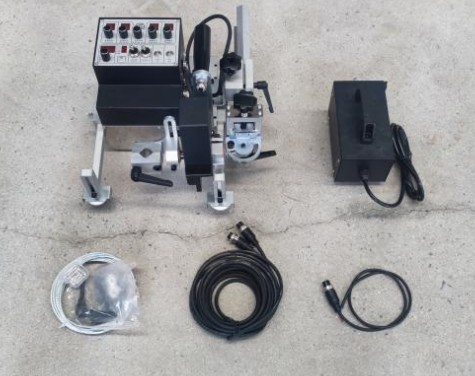
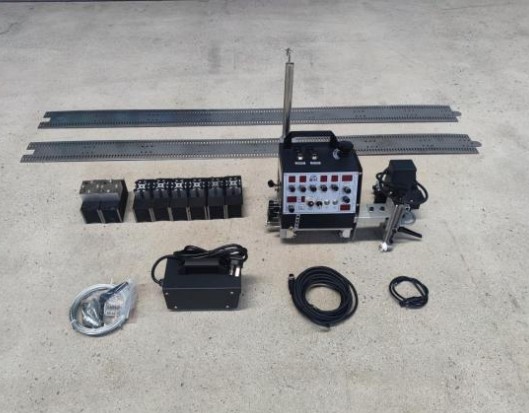
Nobody needs every option. This is what each one changes, and how to tell whether it earns its place in your configuration.
| Choice | What it changes | When it is worth paying for |
|---|---|---|
| Flexible track vs rigid track | RG follows curved shells; ZG holds a truer line on flat plate | Pick by surface: curvature needs the flexible belt, long flat seams reward the rigid rack |
| Magnetic / vacuum / clamping track | Which materials the machine can grip | Carbon steel: magnetic. Stainless or aluminium: vacuum or clamping, no way around it |
| Single vs double torch | Weld both sides of a fillet in one pass | Pays off on long, repeating beam work; not on one-off fabrications |
| Oscillator type Z vs J | Straight swing or angle swing | Angle swing for fillets and wide caps; straight swing for narrow butt passes |
| Anti-drift fixture | Keeps the torch on seam on out-of-round pipe | Essential on pipe welding where roundness varies; skip it on a rigid flat-plate job |
| Battery power pack | Runs without a convenient mains supply | Site work and inside vessels; not needed in a fixed shop bay |
| Spares kit and extra track | Downtime and reach | Pays for itself the first time a consumable fails mid-shift; extra track extends long runs |
The cheapest configuration is not always the one with the fewest options — it is the one with no options you will never use, and every option your joint actually needs.
With those six items we quote a specific configuration and say why each line is in it. If something in your list points to manual welding instead, we will say that too — a carriage that does not fit the job is a bad reference for both of us.
Fillet with leg length, butt with wall or plate thickness, or circumferential with diameter. This decides the machine family before anything else.
Diameter or plate size, carbon steel or stainless, and the minimum thickness where the magnets will sit. Material decides the track variant.
Flat, horizontal-vertical, vertical or overhead. Vertical and overhead work is what makes magnetic adhesion a requirement rather than a convenience.
One 3-metre seam a week and three hundred 3-metre seams a month are different purchasing decisions, and they need different torch counts.
Make and model, or at least current range. The carriage does not include the power source, and the process ceiling sets your real travel speed.
The single most useful thing you can send. A photo of the joint answers in one glance what three paragraphs of description cannot.
Send the weld type, material, plate or pipe size, welding position and a photo of the joint. You get a specific configuration, a specific price, and the reason each line is in it.