Vertical and overhead seams are where manual welding hurts most: the welder fights gravity all day, and the weld quality depends on how steady they still are at four in the afternoon. Magnetic adhesion takes gravity out of the equation.
Ask how a carriage stays on a vertical plate and most people assume the drive does it. It does not. The magnet does. Magnetic blocks in the track or in the wheels generate the holding force, and the drive only moves the carriage along the surface the magnet is already gripping.
That is why vertical and overhead work always comes back to two questions: is the material magnetically permeable, and is it thick enough? Our V-type 12-T magnetic base develop 35 kg of holding force per block at room temperature on thick plate in the vertical position, and the minimum suction thickness is 3 mm — 4 mm for the JJ fillet carriage.
Once those are satisfied, the carriage gives you the same travel speed on a vertical seam as on a flat one, with the same torch angle, for as long as the plate is there.
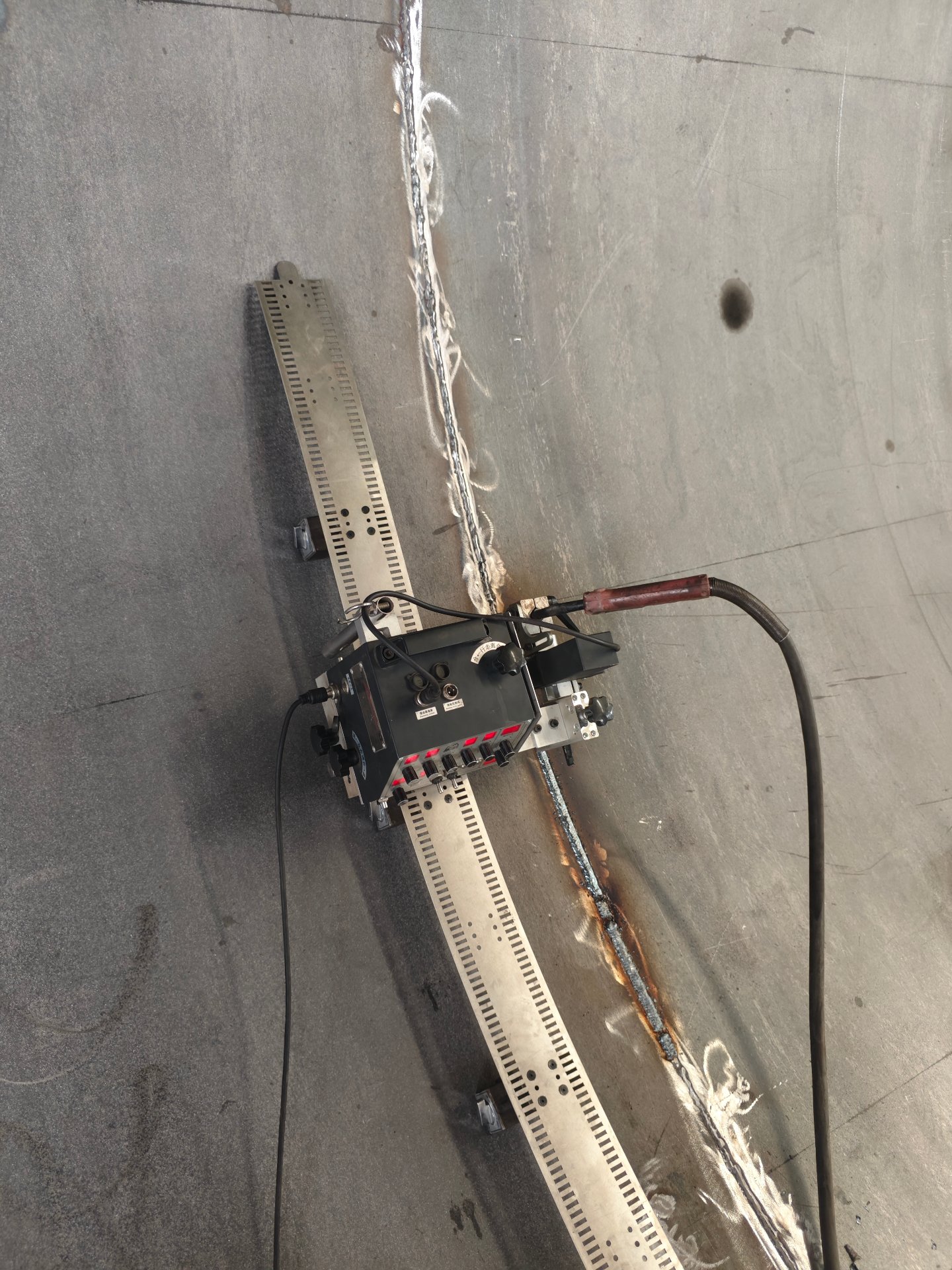
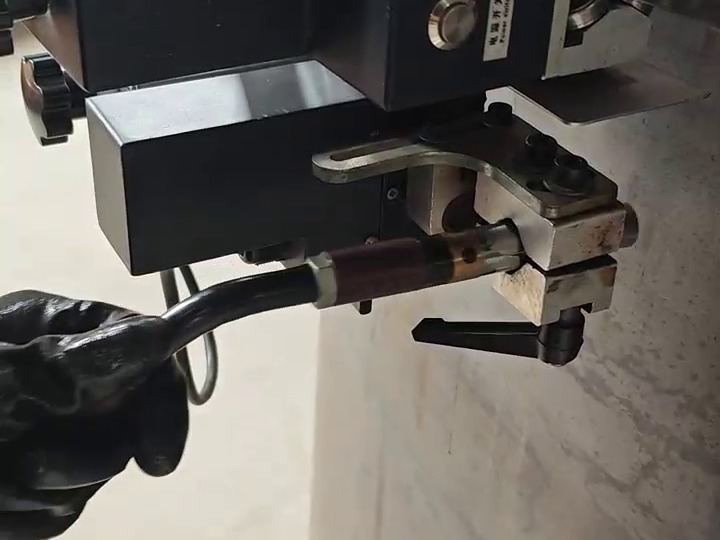
Position decides which machine type you need, and it decides what the biggest risk is. This is the table we work through on the phone.
| Position | Machine setup | Main risk | What to do about it |
|---|---|---|---|
| Flat / horizontal | Any carriage; ZG straight track for long seams | Very little | Standard parameters; this is where a rail carriage is fastest |
| Horizontal-vertical (HV) fillet | JJ / GJ trackless fillet carriage | Torch drifting off the corner | Guide wheels follow the joint; check the guide on the first metre |
| Vertical up / down | RG / ZG magnetic track, or magnetic crawler | Magnetic adhesion on thin or painted plate | Clean the surface; confirm at least 3 mm of ferrous material |
| Overhead | Magnetic version only | Process and operator limits, not machine limits | Talk to us about the joint before ordering; ceramic backing often helps |
| Curved vertical (tank shell) | RG flexible track, or CX crawler | Track lift on tight curvature | Flexible belt conforms; the crawler is the fallback with no minimum diameter |
| Inside a vessel | CX crawler (inner shell from Ø700 mm) | Access and cable management | Plan the cable route and the operator's position before you start |
One practical detail that saves arguments: the 35 kg holding force is quoted at room temperature on thick plate in the vertical position. Hot plate, thin plate, paint, scale and rust all reduce it — so do not size a magnet setup from the datasheet alone on preheated work.
Four steps, in the order that matters. The material check comes first, because it is the one that can stop the job.
Confirm the plate is ferrous and at least 3 mm thick where the magnets will sit — not where the weld is. The carriage travels wherever it is standing, so the travel path is what has to hold.
Wire-brush scale and rust and remove paint along the two tracks the wheels or magnetic blocks will follow. This is the single biggest cause of a carriage letting go or wandering.
Magnetic track mounts in about 15 seconds per rail; check it is fully seated before loading the carriage. On the trackless versions, set the carriage so the torch is square to the joint before switching on.
Vertical welding usually needs a slightly lower travel speed than flat for the same leg size. Set it on a test piece, then keep it — the point of the machine is that pass two, ten and fifty are identical.
Send us the plate thickness, the joint type and the welding position. We will confirm whether magnetic adhesion is enough for your setup and which carriage fits.