Little Gecko® welding carriages · Engineering, QC & worldwide export from Beijing, China
Home / Applications / Storage Tanks

Storage Tank Welding Machine — Shell Seams Inside & Out

Tank shells are curved, tall and welded from both sides — the worst case for manual welding and the best case for a flexible-track carriage that follows the shell on its own, no scaffolding required. If you are comparing a tank welding carriage for shell seams, this setup is what takes a shop from manual welding to automatic tank welding without adding a rotator or a column-and-boom — the flexible track works as the automatic welding machine for tanks.

Storage Tank Welding

The shell is the jig — the track clings to it

Manual welding on a tank means working at height, overhead on the inside, and reaching around a curve. Quality depends on which welder climbed the scaffold that morning. A flexible-track carriage turns the shell itself into the guide rail: mount the track, set the parameters, and the seam gets welded the same way on every ring and every panel.
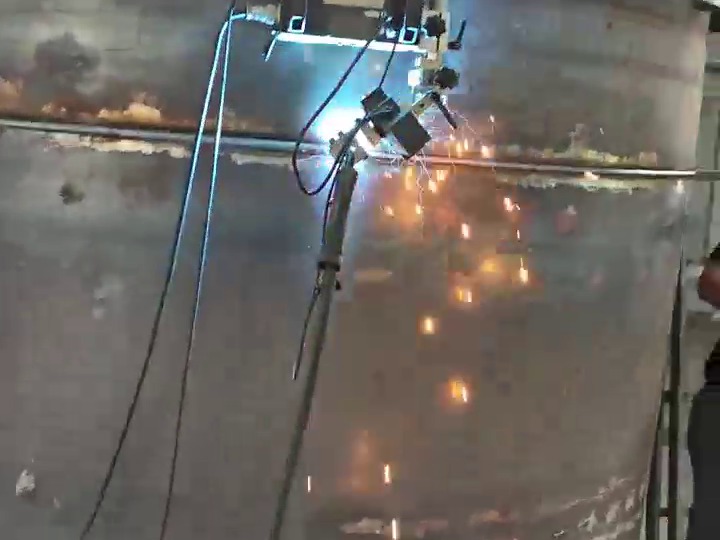
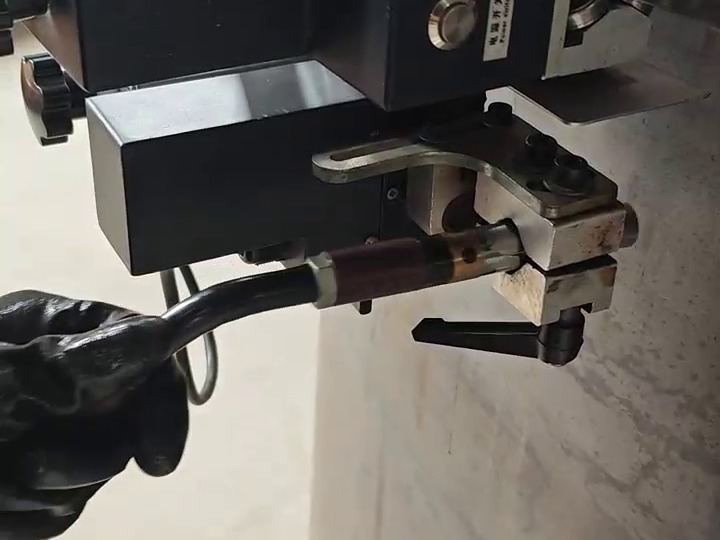
  • Horizontal and vertical seams on tank shells from Ø1800 mm upward
  • Carbon steel ≥3 mm — welding on the inside and outside of the shell
  • Smaller tanks Ø700–2000 mm and stainless shells handled by the same family
  • Track alternates and re-joins endlessly — one track set serves the whole tank
What we recommend: RG-III-Q1 flexible-track carriage — /C magnetic track for carbon steel, /X vacuum-suction track for stainless shells, /B clamping track for the Ø700–2000 mm range. Angle-swing version (RG-III-Q1/J-C) for vertical seams.
The difference: The belt track grips the curved shell without scaffolding or clamps, and the same parameter set repeats on every ring and every panel — so weld quality no longer depends on which welder came in that morning.
See the RG Flexible-Track Carriage
RG flexible-track carriage welding a tank shell seam with sparks — real photo RG flexible-track carriage torch and clamping unit close-up — real photo
Seam Types We Cover

Which Carriage Welds What in Storage Tanks

Typical joint / seamRecommended machine
Horizontal circumferential seams on the shellRG-III-Q1/Z-C flexible track, straight swing
Vertical seams on the shellRG-III-Q1/J-C flexible track, angle swing
Inside shell welding (confined space)Same carriages — DC 24 V low-voltage operation
Small tanks Ø700–2000 mmRG with /B clamping track
Watch It Work

Automatic Tank Shell Welding — Flexible Track in Action

Flexible-track carriage welding a curved shell seam — real footage
FAQ

Storage Tanks Welding — Common Questions

Our tank is stainless steel — will magnetic track work?
No, and we plan for that: specify the /X vacuum-suction track for stainless shells, or the /B clamping track for smaller diameters. The carriage and oscillator are unchanged — only the track fixing method differs, and all three mount in seconds.
Can one track set really weld a whole tank?
Yes — that is how they are used. The 1784 mm belt rails join through quick-plug connectors and can be linked to any length; you leapfrog the rear rail forward as each seam completes. One set of rails plus one set of magnetic blocks serves the entire tank, ring after ring.
How do you weld the inside of the shell?
The same carriage works inside: the track fixes to the steel from any side, and the carriage runs on safe DC 24 V. Ventilation and standard confined-space safety rules still apply — the machine removes the welding position problem, not the confined-space procedure.

Building or Repairing Storage Tanks?

Tell us the tank diameter, plate thickness and seam layout — we will confirm the right track type and quote within 24 hours.

Get a Quote