Little Gecko® welding carriages · Engineering, QC & worldwide export from Beijing, China
Home / Guides / Fillet Welding Automation

How to Automate Fillet Welding on H-Beams, Box Beams and Frames

Fillet welds are usually the biggest pile of welding hours in a steel shop, and they are also the most repetitive: the same leg length, the same angle, the same corner, hundreds of metres. That combination is exactly what an angle welding carriage is built for.

Why Fillet First

An angle carriage follows the corner instead of the plate

What makes fillet welding slow is not the welding, it is the position: the welder follows a corner with the torch at 45°, at the same travel speed, for metres at a time. An angle carriage rolls along the workpiece with the torch locked at the correct angle and distance, so leg length stays constant and the bead looks the same at the end of the beam.
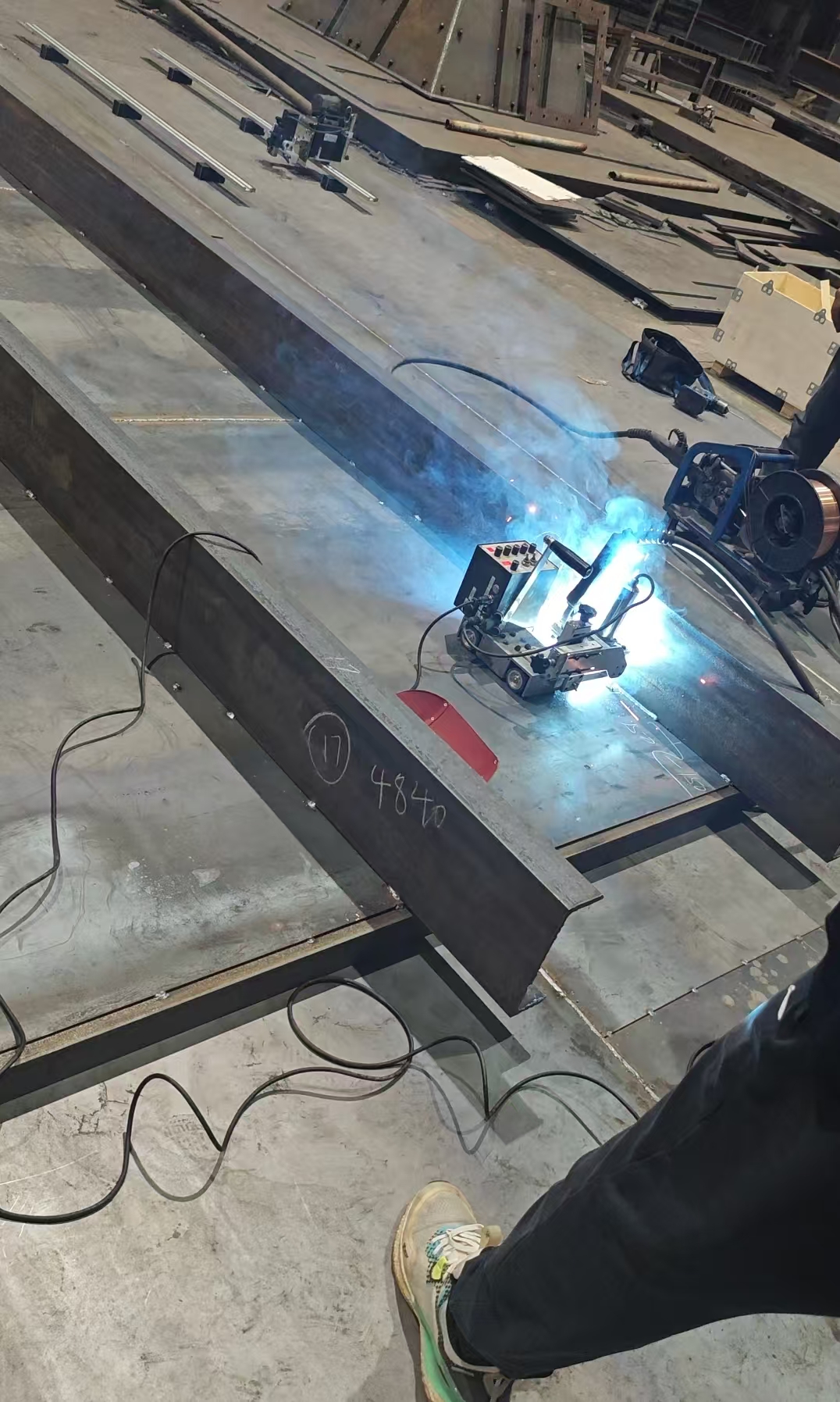
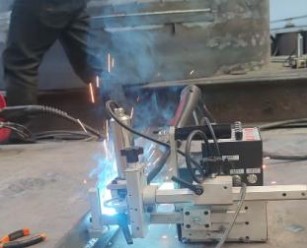
  • Torch angle and stick-out locked by the machine — 45° fillet held accurately over the whole run
  • Adjustable oscillation for leg length and throat thickness
  • Single-torch and double-torch versions — twin torches weld both sides of a beam in one pass
  • Intermittent welding function for stitch welds
  • Runs on flat, vertical or slightly inclined work; magnetic wheels hold on steel
What we recommend: JJ / GJ series angle welding carriage — single torch for access-limited joints, double torch when both legs of an H-beam can be welded at once.
See the JJ / GJ Fillet Carriage
Angle welding carriage welding a fillet weld on an H-beam Automatic fillet welding on a fabricated steel beam
Selection Table

Fillet Joint to Machine

Fillet weld / workpieceRecommended machineNote
H-beam web-to-flange fillet (one side at a time)JJ / GJ single-torch carriageTravelling on the flange, torch at 45°
H-beam both sides in one passGJ double-torch carriageTwo torches, mirror-symmetrical setup
Box beam and column filletsJJ / GJ carriage with guide wheelsGuide follows the corner consistently
Stitch / intermittent fillet weldsJJ carriage with intermittent functionSet weld length and gap length, then repeat
Small brackets and tight detailsManualMachine access does not pay off below a certain size

Leg length consistency comes from two things: a locked torch angle and a constant travel speed. Both are what the carriage provides, which is why fillet welding is usually where shops see the clearest improvement.

Method

Setting Up a Fillet Weld on a Carriage

SET 01

Set the Angle

Torch at 45° to both legs, wire aimed into the root. The carriage bracket keeps it there for the full run.

SET 02

Set the Leg Length

Travel speed, wire feed and oscillation width together determine the leg: adjust once on a scrap beam, then repeat for the batch.

SET 03

Guide Along the Corner

The guide wheel or magnetic wheels follow the joint, so the torch does not wander as the beam bows or the corner varies slightly.

SET 04

Repeat for the Batch

Once the parameters are set, every identical beam in the lot gets the same weld — which is the real gain when you weld hundreds of the same detail.

FAQ

Questions We Get Asked Before the First Quote

Can one machine weld both sides of an H-beam?
Not in one pass with a single torch — the carriage welds the leg it is set up for, then you reposition. For both sides simultaneously, the GJ double-torch version is the answer: two torches on one carriage, one pass down the beam.
Does it work on vertical and overhead fillets?
Vertical and inclined fillets are normal work for the angle carriage, and magnetic wheels hold the machine on the workpiece. Overhead work is limited by the process and the operator, so it is worth discussing the specific joint before ordering.
What about gaps and fit-up variation?
The carriage holds the torch at a constant angle and distance, so a constant gap welds consistently. Where fit-up varies joint to joint, the operator adjusts travel speed at the remote, or you fixture the joint better — the machine cannot compensate for a gap that changes.
Is it worth it for short fillets?
Below roughly a metre of continuous fillet, the setup time can eat the gain. The break-even point is really the batch size: if the same detail repeats all day, a carriage pays off even on short runs.
Keep Reading

Related Pages for Fillet Welding

Welding Beams by the Hundred?

Send us the beam size, fillet leg length and how many pieces you run — we will recommend single or double torch and quote within 24 hours.

Get a Quote