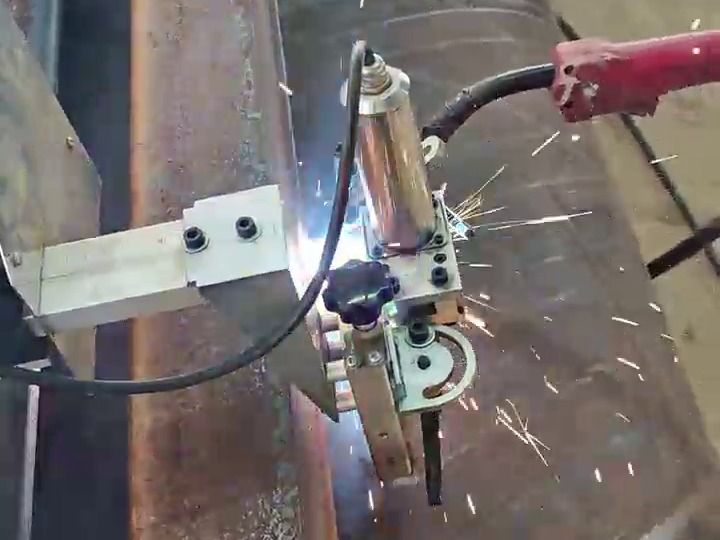
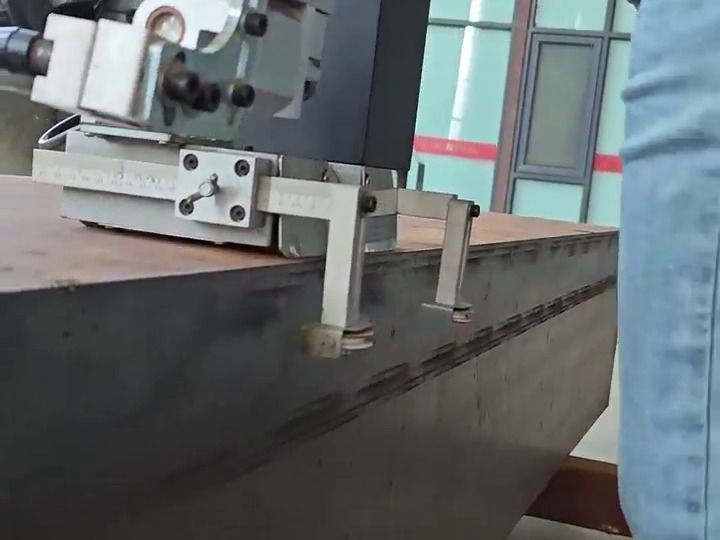
Heavy equipment means thick plate, long multi-pass seams, and parts far too big to turn over. A welding carriage holds the torch on line at a fixed travel speed, so penetration and bead shape stay the same from the first pass to the tenth.
On excavator booms, crane sections, crusher frames and machine chassis the joint is usually a long butt or a heavy fillet on plate from 10 to 40 mm. Welding that by hand is a fight against fatigue: travel speed drifts through the shift, and on multi-pass work the effect multiplies pass after pass. A track-mounted carriage fixes the travel speed and keeps the oscillation settings on the panel between passes.
| Typical joint / seam | Recommended machine |
|---|---|
| Long straight butt seams on plate 10–40 mm (multi-pass) | ZG-III-Q1Z-C on single rail |
| Wide plate and heavy sections | ZG with twin-rail track |
| Frame, chassis, bracket and gusset fillets | JJ-III-Q1/J-W fillet carriage |
| Both fillets of a fabricated frame in one pass | JJ-Q2 dual-torch carriage |
| Circumferential seams on drums, rollers and cylinders | CX-III-Q1Z-W magnetic crawler |
Not sure which of these is your joint? Use the five-step selection guide or send a photo of the workpiece.
Send the plate thickness, seam length and annual volume — we will size the carriage and the track configuration, and quote within 24 hours.