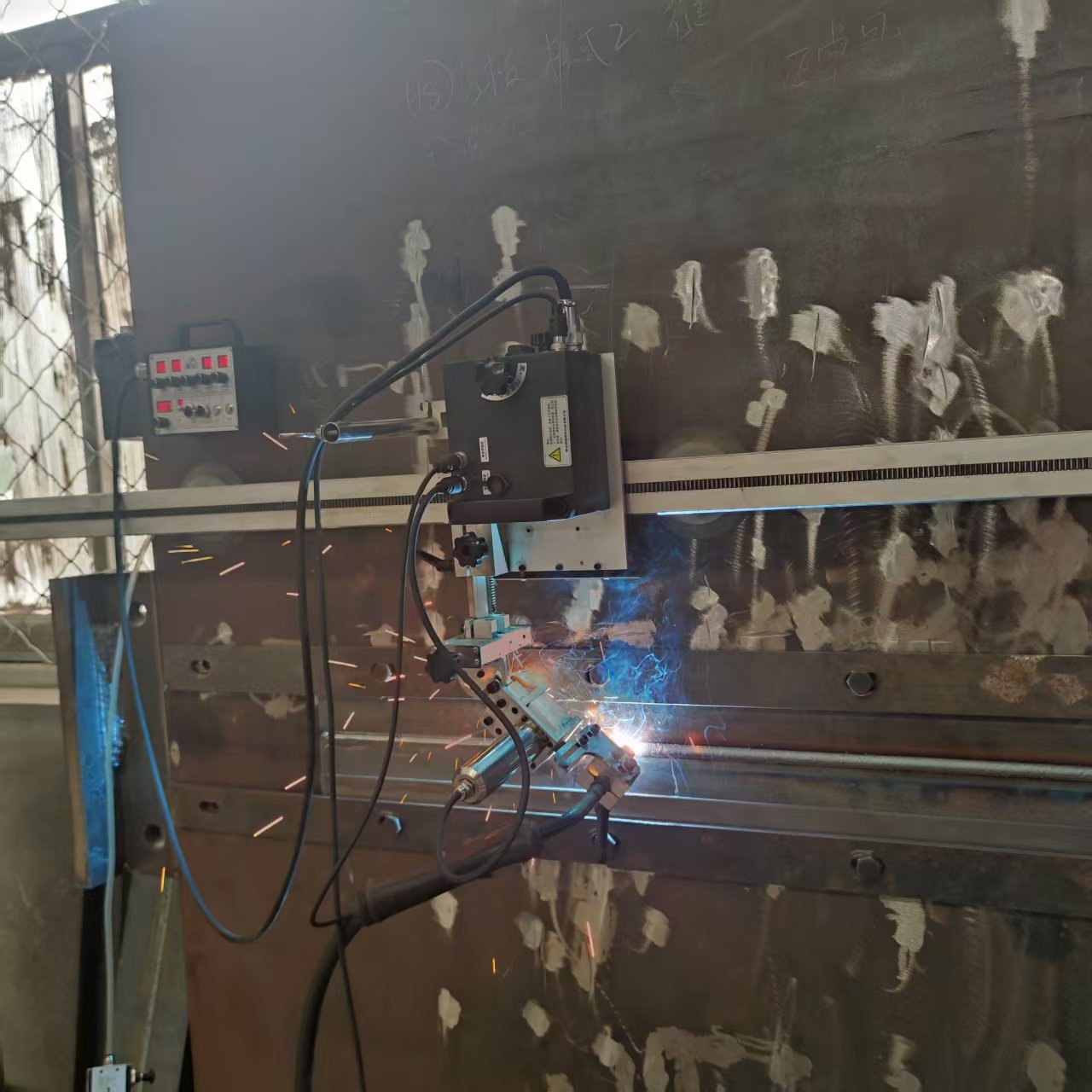
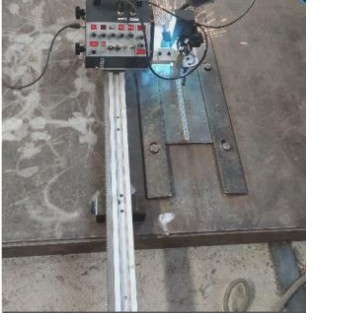
A rigid straight track holds the carriage on a fixed line, which is exactly what a long seam on a flat plate needs. A flexible stainless belt does the same job on a curved shell, an inside corner or a plate you cannot lay flat. Both run at a set travel speed with adjustable oscillation, so the weld no longer depends on how steady the operator's hand is at metre nine.
| Seam / workpiece | Recommended machine | Note |
|---|---|---|
| Long flat butt seam on plate or deck panel | ZG straight-track carriage | Rigid track, single pass or multi-pass |
| Long seam on a curved or formed shell | RG flexible-track carriage | Belt follows the curvature |
| Vertical seam on a tank wall or ship panel | RG flexible-track carriage | Magnetic adsorption, no scaffold |
| Stiffener / rib welds on large panels | ZG with narrow track, or CX crawler | Short seams in long runs — position fast |
| Inside welds in confined vessel sections | RG flexible or CX crawler | Compact machines fit where a fixture cannot |
Set the track parallel to the seam — a carriage follows the track, so any misalignment shows up as weave drift. Two pointers or a chalk line are enough.
Weave width, frequency and dwell time are set per joint; wider weave with dwell at the sidewalls gives penetration without a hot, convex cap.
Run-on and run-off tabs outside the workpiece, or set the carriage to start away from the plate edge, so the crater lands somewhere you can cut off.
For thick plate, stack passes with the same travel speed; the oscillation settings come from your WPS and are simply dialled in again for the next run.
Send us the seam length, plate thickness and position — we will tell you whether a track carriage or a crawler is the better fit, and quote it.